If you’re relying on Online Travel Agents (OTAs) to fill rooms, you’re not alone, but you are leaving revenue on the table. The real opportunity lies in owning your visibility, your data, and ultimately your guest relationships. That starts with a strong, intentional SEO strategy.
Search engine optimization for hotels and resorts isn’t just about ranking higher. It’s about attracting the right travelers, guiding them through a seamless digital experience, and converting that demand into direct bookings.
Let’s break down the SEO best practices that actually move the needle.
Why SEO matters more than ever for hotels and resorts
Today’s traveler journey starts long before they land on your website. They’re researching destinations, comparing properties, reading reviews, and evaluating value.
If your property isn’t visible during those early moments, OTAs will gladly take your place.
A strong SEO strategy helps you:
- Capture high-intent travelers earlier in the funnel
- Reduce dependency on third-party channels
- Improve profitability by lowering commission costs
- Build long-term brand equity and guest loyalty
And in a landscape where hotels are under pressure to prove ROI and optimize spend, SEO becomes one of the most efficient long-term investments you can make.
1. Start with keyword strategy that reflects real traveler intent
Not all traffic is created equal. Ranking for broad, high-volume keywords is less valuable than capturing intent-driven organic searches that lead to direct bookings.
Focus on:
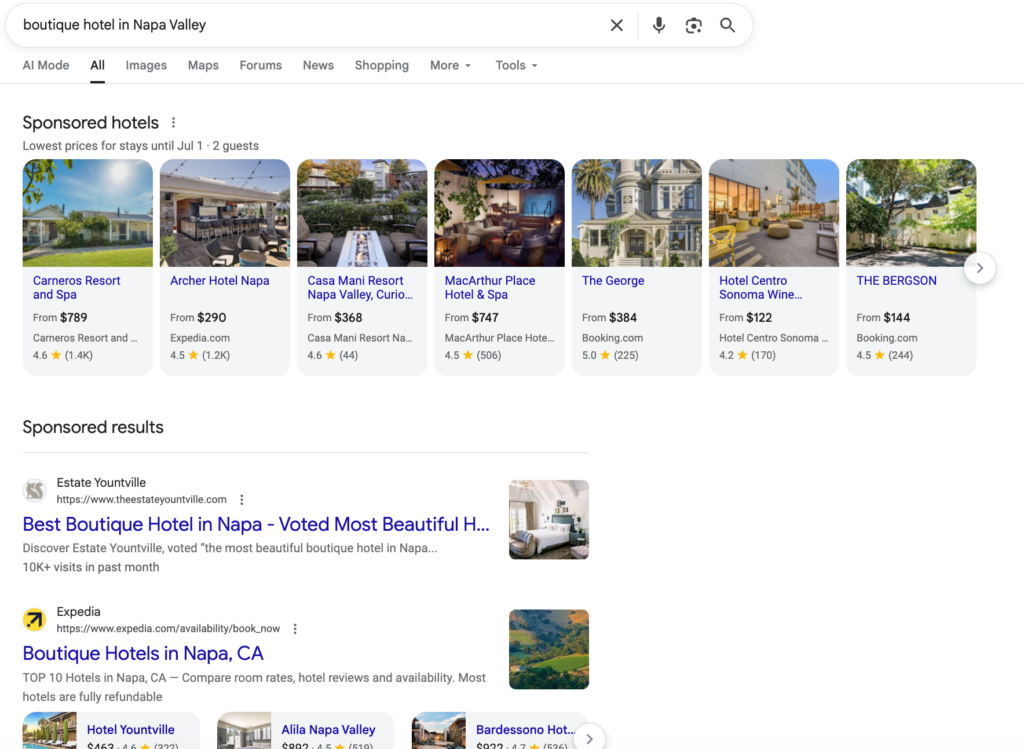
- Location-based keywords: “boutique hotel in Napa Valley”
- Experience-driven organic searches: “beachfront resort with spa in Maui”
- Brand + non-brand combinations
- Long-tail queries that reflect specific needs
The goal is alignment. Your content should match exactly what travelers are searching for at each stage of their journey.
2. Optimize your on-page SEO (the right way)
On-page SEO is where strategy meets execution. Small details here make a measurable difference in rankings and click-through rates.
Follow these fundamentals:
- Title tags (55–60 characters) with primary keywords front-loaded
- Meta descriptions (155–160 characters) with a clear call to action
- Header structure (H1, H2, H3) that’s clean and user-friendly
- Natural keyword placement—never forced or repetitive
The key is balance. You’re optimizing for search engines and humans. Over-optimization or keyword stuffing will hurt both.
These best practices ensure your pages are discoverable without sacrificing readability or brand voice.
3. Create content that captures demand across the organic search funnel
Most hotel websites focus only on bottom-of-funnel pages (rooms, amenities, offers). That’s not enough.
To win in organic search marketing, you need content that supports the full traveler journey:
Top of funnel
- Destination guides
- Things to do in your area
- Seasonal travel inspiration
Middle of funnel
- Comparison content (why your property vs others)
- Experience-focused pages (spa, dining, weddings)
Bottom of funnel
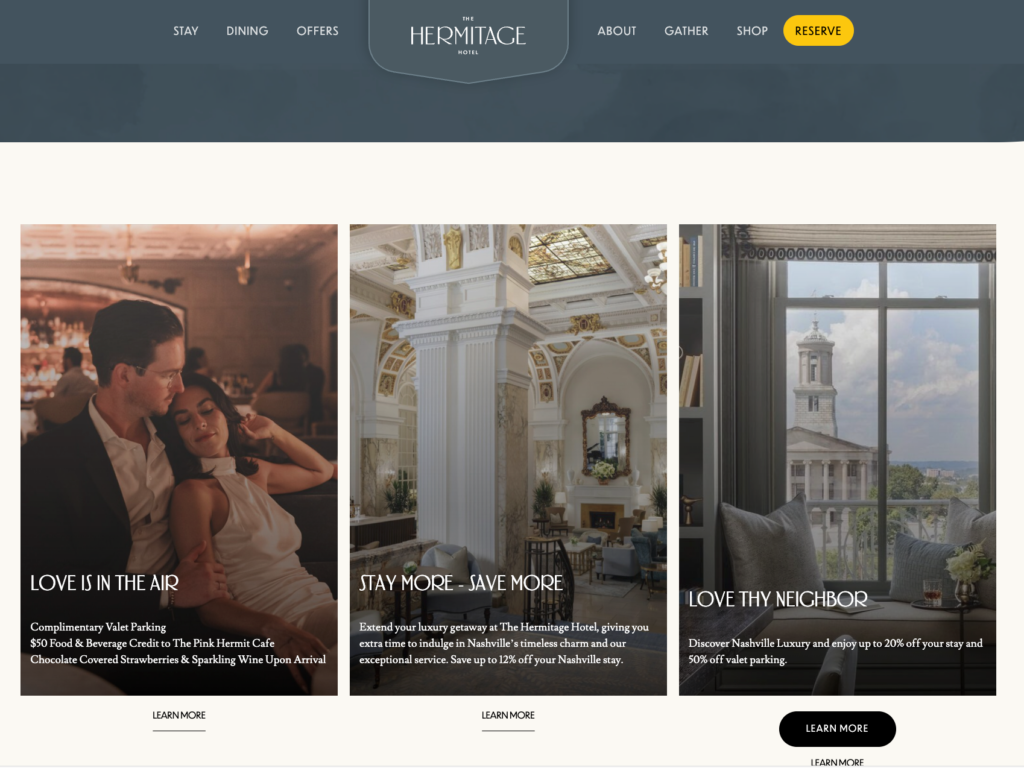
- Room and offer pages
- Booking-focused landing pages
This layered approach increases visibility, builds trust, and guides users toward booking directly.
4. Prioritize technical SEO and site performance
Even the best content won’t rank if your site isn’t technically sound.
Focus on:
- Fast page load speeds (especially on mobile)
- Mobile-first design
- Clean site architecture
- Indexability and crawlability
- Secure browsing (HTTPS)
A slow or clunky website creates friction, and friction kills conversions. For more direction on how to prioritize technical SEO, check out this guide.
5. Optimize for local search and Google visibility
Local SEO is critical for hotels and resorts.
Make sure you:
- Fully optimize your Google Business Profile
- Keep NAP (name, address, phone) consistent across platforms
- Encourage and respond to guest reviews
- Use localized content and schema markup
When done right, this helps you dominate map results and capture high-intent travelers searching nearby or planning specific destinations.
6. Use data to guide organic search marketing decisions (not guesswork)
The most effective organic search strategies aren’t built on assumptions, they’re built on data.
Modern hospitality marketing requires:
- Performance tracking across channels
- Search trend monitoring
- Content opportunity identification
- Competitive benchmarking
When you centralize and analyze this data, you can continuously refine your SEO strategy and focus on what actually drives direct bookings.
That’s where a data-first approach becomes a true differentiator. Platforms that ingest and standardize marketing data across thousands of properties enable smarter decisions, faster optimization, and measurable growth.
7. Align SEO with your broader marketing ecosystem
SEO doesn’t exist in a vacuum. It should work in sync with:
- Paid search and hotel metasearch
- Content marketing
- Social media
- Email campaigns
When these channels are aligned, you create a unified experience that reinforces your brand and increases conversion rates.
This integrated approach is especially powerful in hospitality, where fragmented data and disconnected strategies often limit performance. Bringing everything together unlocks better visibility, stronger insights, and more efficient growth.
8. Design for conversion, not just organic search traffic
Getting users to your site is only half the battle. Converting them is what matters.
Make sure your website:
- Has a clear, intuitive booking path
- Highlights value over OTAs (best rate guarantees, perks)
- Uses strong calls to action
- Builds trust through visuals, reviews, and content
SEO should drive qualified traffic. Your website should turn that traffic into revenue.
Bringing it all together
Organic search marketing for hotels and resorts isn’t about chasing algorithms. It’s about understanding travelers, delivering relevant content, and creating a frictionless path to booking.
The properties that win are the ones that:
- Think beyond rankings
- Invest in data and insights
- Build integrated, performance-driven strategies
Because at the end of the day, the goal isn’t just visibility.
It’s ownership of your traffic, your guests, and your growth.
Ready to increase direct bookings for your hotel or resort?
If you’re looking to turn your SEO strategy into measurable revenue, start with a data-driven approach that connects insights to action.
Explore how your property can capture more demand, and convert it into direct bookings now.
{
“@context”: “https://schema.org”,
“@type”: “FAQPage”,
“mainEntity”: [{
“@type”: “Question”,
“name”: “1. How can SEO help increase direct bookings for hotels and resorts?”,
“acceptedAnswer”: {
“@type”: “Answer”,
“text”: “
SEO helps hotels and resorts capture high-intent travelers earlier in their booking journey by improving visibility in organic search results. By aligning content with traveler intent, optimizing site performance, and targeting the right keywords, properties can reduce reliance on OTAs and increase direct bookings while improving profitability.
”
}
}, {
“@type”: “Question”,
“name”: “2. What role does Google Hotel Ads and hotel metasearch play alongside SEO?”,
“acceptedAnswer”: {
“@type”: “Answer”,
“text”: “
While SEO builds long-term organic visibility, hotel metasearch and Google Hotel Ads complement it by capturing demand at the decision stage. Together, they create a full-funnel hospitality marketing strategy that drives traffic, reinforces brand presence, and maximizes direct bookings across channels.
”
}
}, {
“@type”: “Question”,
“name”: “3. Should hotels manage SEO in-house or work with a hospitality marketing agency?
“,
“acceptedAnswer”: {
“@type”: “Answer”,
“text”: “
Many hotels and resorts benefit from partnering with a hospitality marketing agency or digital marketing agency that understands the complexities of hotel distribution, data, and traveler behavior. An experienced marketing agency for hotels and resorts can align SEO with broader strategies, such as paid media, hotel metasearch, and analytics, to drive measurable growth and increase direct bookings.
”
}
}]
}
Frequently asked questions about organic search marketing
SEO helps hotels and resorts capture high-intent travelers earlier in their booking journey by improving visibility in organic search results. By aligning content with traveler intent, optimizing site performance, and targeting the right keywords, properties can reduce reliance on OTAs and increase direct bookings while improving profitability.
While SEO builds long-term organic visibility, hotel metasearch and Google Hotel Ads complement it by capturing demand at the decision stage. Together, they create a full-funnel hospitality marketing strategy that drives traffic, reinforces brand presence, and maximizes direct bookings across channels.
Many hotels and resorts benefit from partnering with a hospitality marketing agency or digital marketing agency that understands the complexities of hotel distribution, data, and traveler behavior. An experienced marketing agency for hotels and resorts can align SEO with broader strategies, such as paid media, hotel metasearch, and analytics, to drive measurable growth and increase direct bookings.
The post Quick-start guide to driving direct bookings through Organic Search appeared first on GCommerce Solutions.
