Eyval in Bushwick.
Photo: Dean Majd
In the 2010s, Israeli chefs — some who made their name in the U.S., some famous–in–Tel Aviv restaurateurs — started racking up wins in New York. This was a falafel- and bagel-literate society, urbane, health-conscious, every kitchen with a copy of Yotam Ottolenghi and Sami Tamimi’s Jerusalem cookbook stashed next to a once-used tube of harissa and Michael Pollan’s dictum (“Eat food. Not too much. Mostly plants.”) ringing in our ears. The new Israeli restaurants weren’t just popular because ours is a Jewish-ish town. The self-fashioned pluralism of what the press sometimes called New Israeli cuisine mirrored and flattered New York’s cosmopolitan self-regard. It was salad-forward, za’atar-laden, full of grilled meats, flatbreads, and fenugreek. We were told this was the flavor profile of this young country, which was so richly funded and supported by our own. Israeli cuisine was an idea the American food Establishment could get behind: food from a melting pot just starting to cook.
The most popular dishes were Mizrahi, Arab, North African. Some were imported by Jewish immigrants. Many of the dishes were Palestinian. “Israeli cuisine is based on two things: on Palestinian cooking and on ethnic cooking,” an Israeli food editor told a reporter in 2013, joking that “if you want to succeed in Israeli cooking, you better have a Moroccan grandmother, and if you don’t — you better invent one.” The chef Meir Adoni, who does have one, said a crucial inspiration was “the Arabs’ influence.” When he opened his New York restaurant, Nur, in 2017, he served a raw-beef dish he called “Palestinian tartare”; it was his take on what’s known to Arabic speakers as kibbe nayyeh. Einat Admony, a chef with Persian and Yemeni Jewish roots who got into cooking while serving in the IDF, made her name with the falafel shop Taïm before turning it into a takeout chain and opening dinner spots like Balaboosta. Chef Eyal Shani, famous in Israel, did fast-casual with Miznon, went upscale, then later won a Michelin star with Shmoné. By the time Michael Solomonov opened rooftop grill house Laser Wolf in Williamsburg in 2022, his style of cooking needed no introduction. Within weeks, Laser Wolf’s reservation waiting list was stretching into the thousands.
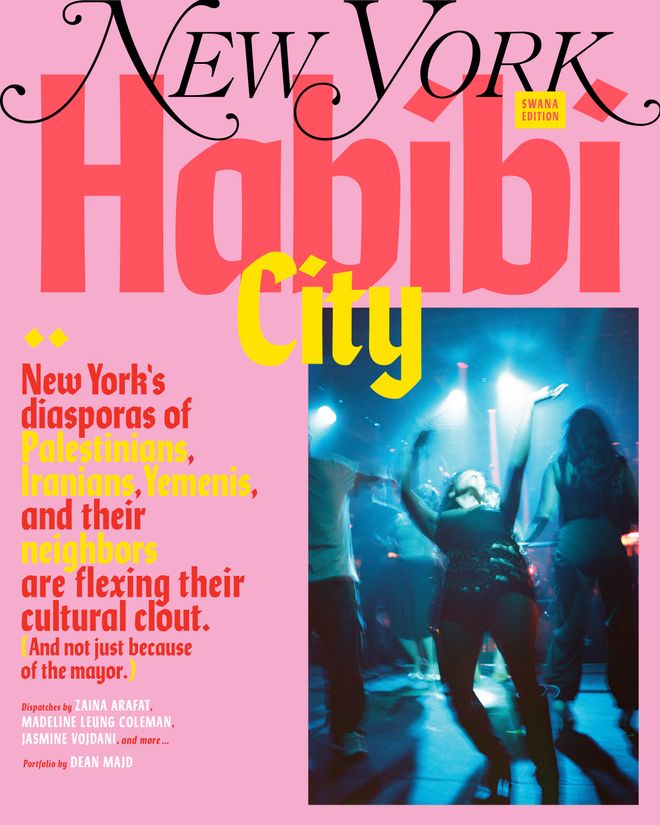
Habibi City
See All
There had been Israeli chefs in the city for nearly all of Israel’s existence. There had been Syrian and Lebanese chefs here even longer. With few exceptions, however, most Arab, Iranian, or North African restaurants were assigned their role: cheap, quick, outer-borough. The food they made was relegated to halal carts outside your office and blandly exotic midtown dinner spots, mezze platters on Atlantic Avenue and grill houses in Bay Ridge. Some of these places served excellent food. But they tended to submerge their origins in euphemisms: They called their food “Oriental,” then “Mediterranean.” The New Israeli chefs cruised free of post-9/11 baggage, happy to announce their connections to Israel and talk about the Tel Aviv food scene. Unhindered by the stereotypes that dogged other Middle Eastern food, the promoters of New Israeli cuisine gave themselves permission to be expensive.
They’re not the only ones doing that now. More and more Middle Eastern chefs and owners are opening the kinds of restaurants that get booked out, hyped up, and earmarked for an extra-special dinner — and they’re being specific about exactly what they want to cook. When the spare and elegant Iranian restaurant Sofreh opened in Prospect Heights in 2018, it was both incredibly popular and the first Persian place many of its customers had tried. Over the past five years, it’s been joined by peers: There’s now clean, sunny, subway-tiled Eyval in Bushwick, owned by a former Sofreh chef, where Persian dishes like kebab koobideh slide in with luscious yogurts, cheffy salads, and savory cocktails. Stainless-steel-sleek Little Flower Cafe in Astoria and Diljan Bakery in Brooklyn Heights, run by an Afghan American duo. Fuzzy-chaired, marble-countered Café Habibti in Greenwich Village, which serves a Pakistani take on Persian sharbat. Levantine home cooking and house arak at Huda in Williamsburg. Modern Lebanese at Sawa in Park Slope. Bountiful lamb and flatbreads at the Palestinian place Al Badawi on Atlantic Avenue and the Upper East Side. Yemeni coffeehouses in the Bronx and Williamsburg alike. And everywhere from the Upper West Side to Bay Ridge, there’s Ayat, the Palestinian restaurant that in 2023 had one location and now has ten.
Maybe there was a time when a lot of diners didn’t know the difference or care: Israeli or Iranian, it was all “Middle Eastern.” You’d have to work to ignore the difference now. In the three years since October 7, awareness of Israel’s genocide of Palestinians and the wars that keep proliferating have turned eating out into just one more way people are expressing their views on Israel, on Gaza, on Lebanon, on Iran. When in 2024, a reporter asked Admony if the war had affected her business, she said, “We are busy. We are doing good. A lot of people only eat in Israeli restaurants since October 7.” And while pro-Israel New Yorkers have doubled down on supporting Israeli restaurants, those horrified by the genocide are turning away — and toward chefs who they would rather support. Jumana Bishara, co-owner of Palestinian restaurant Tanoreen, remembers the “Mediterranean” days, when it felt like going vague was the only way to get people in the door. “After October 7, people were coming here to specifically support a Palestinian restaurant,” she says. “It was the only positive thing against the backdrop of the genocide.” The new SWANA chefs have emerged proud to declare their origins, to give themselves room to experiment, to play, and, finally, to charge more for their food. They know it’s worth it.

Ali Saboor in the kitchen at Eyval.
Photo: Dean Majd
In 1899, a New York Times reporter named Cromwell Childe tried flatbread and it sent him spiraling. “A Syrian loaf is like unto a gigantic circular corn cake,” he wrote. “It is of wheat, puffs at the centre, and when broken is discovered to be little more than a well-browned outer crust.” Childe was visiting the first Arab neighborhood in New York, an area downtown around Washington Street that had sprouted up in the 1880s and was called the Syrian Colony or Little Syria; Greater Syria was the Ottoman-era term for a region that sprawled through and across the Levant, and New York’s earliest “Syrians” came from everywhere from Beirut and Aleppo to Palestine. The first version of Sahadi’s, the grocery store whose flagship is now on Brooklyn’s Atlantic Avenue, was opened in Little Syria in 1895 by a family from what is now Lebanon. Reporters made pilgrimages and wrote back with awe. In 1903, the New-York Tribune described a typical lunchtime meal for a prosperous Syrian: “He drinks the fiery arrack, which is to him what the cocktail is to the American … With two or three genial companions he orders a luncheon of laban, or curds of milk, makshie, or minced meat and rice wrapped up in grape leaves or stuffed into a squash gourd, and some grapes for dessert.” After a smoke, this type of man “lingers over a tiny cup of coffee, as black as Erebus, and talks interminably about the Sultan and Tammany Hall.” By the time the city cleared out the area to construct a tunnel in the 1940s, many of the remaining businesses had decamped for New Jersey or Atlantic Avenue — a location chosen because it was just a short ferry ride away.
It’s a truism that most immigrants to the U.S. don’t work in restaurants because they have a passion for cooking. They cook because it’s the best available option. One of the first Yemeni families to do brisk business around Atlantic Avenue was the Almontasers, who began immigrating to the U.S. around the middle of the 20th century; a generation of siblings and cousins opened restaurants along Atlantic and Court Street and in Brooklyn Heights — the Almontaser Restaurant, Near East, Atlantic House, Moroccan Star, Adnan, Bilqis Yemen. Upwardly mobile New Yorkers came to see dining and shopping on Atlantic Avenue as a way to travel in place, a kind of at-home tourism, like visiting Chinatown. Dr. Debbie Almontaser, whose uncles owned two of the restaurants, says her relatives’ self-billed “Oriental” restaurants didn’t focus on Yemeni dishes they ate at home, like aseed, a luscious dough whipped into a mound and sometimes served with soup poured into the center or around the sides. Instead, they served French-inspired Continental dishes, like frogs’-legs Provençal, and Levantine hummus, baba ghannouj, and shish kebab — with, at most, a Yemeni dish or two. “I think they landed on that because they saw that places like Sahadi’s were becoming mainstream public destinations for food and were like, ‘We need to replicate this,’” she says.
By the mid-20th century, musicians from the new state of Israel moved to New York and opened clubs; one in Greenwich Village, El Avram, billed itself as a “Mediterranean Restaurant/Nite Club.” In the ’60s, Pierre Borday, a Lebanese actor turned casting director who first arrived in New York a decade before, decided to open what may have been one of the city’s first falafel shops. “Why did he do falafel?” says one of his sons, Robert Borday. “Maybe because he saw something in the way hot dogs were being sold in America.” Another son, Noel Borday, adds, “At the time, no one had really put falafel, hummus, and baba ghannouj together as a fast-food idea.” It wouldn’t have worked if the ingredients weren’t so easy to get: fresh pita from his best friend’s family’s bakery, Damascus on Atlantic; tahini from Sahadi’s or Malko Brothers. Around 1967, Pierre opened his first shops on 14th Street in Manhattan, later converting a hot-dog cart to flog falafel on the street. (For a while, his Palestinian American wife made the falafel mix in the basement of their house.) He opened one Pierre’s Falafel, then another; his sons went on to open falafel businesses of their own. One of Pierre’s shops on Court Street is recommended in the 1977 edition of budget food guide The All New Underground Gourmet, co-written by New York co-founder Milton Glaser. The mention is glowing if mistaken about his origins: “Pierre Borday’s energy in bringing falafel to the farthest reaches of the city has made this Israeli’s import a formidable contender in the fast-food race.”
In 1971, Pierre passed off his lease on a Macdougal Street storefront to a Syrian immigrant named Mamoun Chater who opened his own shop, Mamoun’s. It’s now one of the oldest in the city with a bunch of locations and a signature recipe: a chomp through the crust of a Mamoun’s falafel reveals a deep-green interior, its shaggy ground-chickpea mixture rich with herbs. Galal Chater, one of Mamoun’s sons, says they lived peacefully cheek by jowl with Israeli neighbors. It was a more malleable time. It may have felt like, in a country where most people couldn’t find the Levant on a map, they had more in common than not. Muslim, Jewish, and Christian Arab musicians jammed and recorded together, performed at weddings and bar mitzvahs. The chef at El Avram, the Israeli “Mediterranean Restaurant/Nite Club,” was Egyptian. As one regular at Israeli-owned Café Feenjon later told a reporter, though “none of us quite realized it, we were the inheritors of the defunct Ottoman Empire.” Noel Borday remembers hawking his dad’s falafel at an event for Israeli National Day in the late ’70s. Galal Chater says one of his father’s best friends was an Israeli guy who managed the Blue Note and gave great business advice, and they were tight with the Dwormans, who ran Café Feenjon before opening the Olive Tree Cafe and Comedy Cellar next to Mamoun’s; Galal heard it was his father who encouraged Manny Dworman to buy that building. When Galal was growing up on Macdougal, there were enough Arabic speakers in the neighborhood that his older relatives could get by on no English. Even so, many of the people who came through their shop were trying falafel or shawarma for the first time.
Middle Eastern restaurant menus echo across the decades: the mezze, the chopped salads, the grilled meats, the rice. When Samaya Boueri Ziade, the owner of Sawa, moved to New York from Lebanon in the early aughts, she and her Lebanese friends went to Bay Ridge restaurants like Le Sajj, where you might watch a belly dancer during dinner and where they ordered what she calls typical Lebanese restaurant food: tabbouleh, hummus, kibbe, cheese rolls, kofta. “The menu at restaurants was very different from what you make at home,” she says. Many of the most elaborate and beloved dishes from this region only come out of home kitchens, sometimes because they’re considered too complicated, time-consuming, seasonal, or sensitive to prepare for service. But a dogged chef can adapt them — and what nearly all the new, more upscale Middle Eastern restaurants have in common is that they do.
Gehad Hadidi, the Syrian American chef and owner of the Williamsburg restaurant Huda, was so determined to only offer homestyle food that he didn’t want to sell hummus or pita. He caved after customers kept asking for them — but, he told me triumphantly, “We still don’t serve rice!” What he really wanted to highlight was dishes like shish barak; at Huda, the delicate, hand-shaped beef dumplings come out plump and juicy, perched atop a yogurt pond marbled with Aleppo pepper–infused oil and showered in pine nuts and ribbons of herbs. “It’s one of those things where, if you get that at home, you’re like, Wow, either we have really important guests coming or someone really loves me,” says Hadidi. At Tanoreen, Jumana Bishara and her mother, Rawia Bishara, who founded the restaurant, were eager for me to try a dish made with khubayzeh, a wild Palestinian mallow that Rawia used to bring back in her suitcase from their home in Galilee before finding a Palestinian farmer in Pennsylvania who grows it. The khubayzeh was sautéed and silky, the gentle greens topped with twists of fried onion and salty black olives. At Sawa in late winter, Boueri Ziade offered a stew made with tahini, clementines, and Seville oranges, possible to cook only when those oranges are in season.
Ali Saboor, who was born in Iran and spent his adolescence in Orange County, California, worked at Sofreh alongside the owner, Nasim Alikhani, to help adapt her home cooking into dishes that made sense to offer at a restaurant. Now at his own restaurant, Eyval, he’s free to obsess. He can’t stop tweaking his version of ghormeh sabzi, a canonical Persian stew made with mountains of finely chopped herbs, kidney beans, and tender beef, bolstered by the tang of preserved lime. The flavors are deep, savory, nonobvious, adult. When I dined at Eyval recently, Saboor and his crew served it with a long halved beef bone balanced across the top of the bowl, its core of glistening marrow ready to be scooped into the stew and slurped. Saboor does not pretend to be a traditionalist; the dishes he cooks are pulled from regions across Iran, and some are pure seasonal improv, like a salad that offers peaches and plums, sliced into fat wedges, with dollops of farmer cheese, just enough lamb bacon, and a glowing sauce made from the pickled-mango condiment called amba. He has been surprised to find that if any Persian customers are disappointed with his playing around, it tends to be the young ones, who say things like, “This is not how my grandma made it.” But a lot of people just get emotional — like the guy who told him, “None of this looked anything like Iranian food, but man, when I tasted it, everything tasted like my childhood.”
The confidence to make food that can do both might be what is really new. At Ali Zaman and Mohamed Ghiasi’s Astoria spot Little Flower, which Mayor Mamdani has cited as one of his favorite cafés, the star drink is a perfectly postable pink Afghan chai. The star pastry is a doughnut filled with firni, an Afghan cardamom milk pudding. The dish I ordered at Little Flower wasn’t obviously Afghan at all: I got the cheeky “Cwunchwap Supweme,” a trademark-dodging ode, and it was just what you’d want and expect: a flour tortilla crammed with ground beef, tostada, and cheese sauce. It was toothsome and halal and delicious with a well-balanced spice that made total sense scarfed down between sips of the chai. Zaman and Ghiasi are both sons of Afghan immigrants whose own adventures in food world run the gamut: Zaman’s dad, Sami, drove a cab, then ran a fruit stand and a midtown coffee cart. Their respective fathers owned fried-chicken shops — a common gateway business for Afghan immigrants — and now each own Afghan kebab restaurants in Astoria and Ditmas Park. Zaman and Ghiasi share that hustle. Their polished Brooklyn Heights bakery, Diljan, where the executive chef is Honduran American Bryan Ford, serves laminated pastries bursting with delicate saffron-scented cream and long Afghan flatbreads displayed like the crown jewels inside a minimal glass case. When I visited Little Flower in the middle of a weekday, the woman sitting across the table from me said she was visiting New York from L.A.; she’d made a special trip from her hotel after seeing Little Flower all over TikTok. When the lunch hour hit, there was a line out the door.
The new Middle Eastern restaurant owners are aware their food will be politicized — how could they not be? Restaurantgoers make their preferences known. Before October 7, a Jewish friend tells me, she thought nothing of going to Israeli restaurants like Miss Ada. After, horrified by Israel’s genocide, she and her other Jewish friends started consulting restaurants’ social-media posts to discern the owners’ political views before agreeing to eat there — while her pro-Israel parents became much more adamant about buying Israeli wine and eating at their preferred Israeli restaurant chain. “They think it’s righteous, like they’re supporting their people by getting a waffle there,” she says. Plenty of people choosing Palestinian restaurants instead feel the same way.
Ayat’s menus currently include a cheerful tourist-style map in which the land mass currently called Israel is titled “Discover Palestine.” Not everyone is so combative. Boueri Ziade, the Sawa owner, was motivated to open in 2024 because of a series of recent crises in Lebanon, where she was born and raised. “I genuinely felt like there was a part of me that was going to disappear,” she says. Her advocacy through Sawa has focused on fundraising for the Lebanese Red Cross and other nonprofits as well as stocking wine from Lebanon. Eyval has stocked Palestinian wines and Saboor believes Palestinians “deserve to have control of their borders and deserve to have rights.” But he’d eat at an Israeli restaurant too. “For me, hospitality means open arms to all, so I don’t view my space as political,” he says. In September, he’ll cook at an event in upstate New York hosted by Einat Admony.
Huda opened just a couple weeks after October 7, timing that made Hadidi wonder if he should delay in case there was an outburst of anti-Arab sentiment. He discovered, instead, that “the Arab community needed community even more.” When Spain, a national team seen as being pro-Palestine, made the World Cup final, Huda’s Instagram promoted its screening of the match with a 2008 photo of the Egyptian soccer player Mohamed Aboutrika lifting his jersey after a match to reveal a shirt that said SYMPATHIZE WITH GAZA. Zaman, who’s working with Ghiasi on opening what he describes as a “halal Dean & DeLuca” in Astoria, made the Palestinian flag Little Flower’s profile picture on Instagram and posts Muslim memes on main. “I’ve definitely had people hit us up and say, ‘You’re a terrorist,’ or ‘Hamas supporter,’ or ‘Get the fuck out of this country,’” he says. He rejects the claim sometimes forwarded by Israel supporters that anyone would do this to be cool. “It’s not a trend to believe in human rights and the dignity of a group of people that are being massacred,” he says.
There is no way to please everyone. The Israeli chefs Daniel Soskolne and Loren Abramovitch don’t own a restaurant, nor do they want to; they cook independently under the name LEV, hosting regular pop-ups at an event space in Bed-Stuy where they could be described as the chefs in residence. One ongoing project is a tricked-out hot-dog cart they have parked in front of the former REI space in Soho, where on a recent weekday they were serving kebab sandwiches with zhug, chicken-schnitzel salad, gazpacho, and a potato-and-egg brika, a savory Tunisian pastry kissed by the deep fryer and topped with swatches of harissa, zhug, and preserved lemon. In 2021, as their profile was rising, they were called out by the Palestinian artist Amanny Ahmad, who posted on Instagram that LEV “made a career out of cooking Palestinian food (under any name but that).” They were shocked; Abramovitch describes it as a “loss of innocence.” They think it was unjust and can’t help but protest. They are now, however, avoiding cooking falafel. “Deep, deep in my mind, I think I have all the authority in the world to make falafel, but at the same time, I understand that it’s going to be a mess because people want to accuse us that we are appropriating Palestinian cuisine,” says Abramovitch. Soskolne is frustrated that their cooking even gets defined as Israeli. “We never nationalized our food, not because we’re afraid or ashamed,” he says. “We have so much influence from all over the world. Some of it is Jewish, some of it is not.”
After October 7, as Israel began its retaliation against Gaza, Abramovitch persuaded Soskolne that they should post about what was going on. On November 9, they wrote on Instagram that they and their friends and family in Israel were “suffering from the horrific and brutal acts on Oct 7th” and “suffering from the massive killing in Gaza, the killing of so many innocent people must stop.” They were both criticized by pro-Palestine posters who saw their sympathy for Israelis as unearned and inundated with texts and calls from pro-Israel Jewish clients telling them to take down the post because it expressed sympathy for Palestinians. “They’re like, ‘Are you stupid? What are you doing?’” says Abramovitch. “They don’t understand that we don’t see the world in the same way.” They lost those clients. But they say their business is doing fine without them. They tell me they now both consider what the Israeli government is doing to Palestinians to be genocide.
For some, it’s been easier to not say anything at all. That seems to be the strategy for Tomer Blechman, whose decision not to speak or post about the war publicly has left many fans of his restaurants Miss Ada and Theodora confused about where he stands. (He declined my request for an interview.) In the last few years, some Israeli restaurants have been vandalized, spray-painted with notices that accuse them of co-signing the Israeli government’s project. This may be one reason why some are staying silent. Others, like chef Eyal Shani, leaned in: In November 2023, on the day his West Village restaurant Shmoné received its first Michelin star, Shani was serving food to IDF troops near the border with Gaza. Many Israeli chefs landed somewhere in between: hosting fundraisers, making content, writing op-eds. Admony took to wearing the yellow-ribbon pin symbolizing the Israeli hostages and continued to collaborate on videos with Zionist influencer Yoav Davis; according to a report by the Quincy Institute for Responsible Statecraft, public financial filings show that Davis was paid over $160,000 by a contractor working for the Israeli government to produce pro-Israel social-media content. (Admony did not respond to multiple requests for an interview but noted that she was not paid for her appearances in Davis’s videos.)
Perhaps more than any other Israeli American chef, Michael Solomonov has been credited as both a co-creator and a face of the concept of Israeli cuisine, which was even more amorphous when he and Steve Cook opened Zahav, the first of their many Philadelphia restaurants, in 2008. The pair published a best-selling cookbook in 2015, Zahav: A World of Israeli Cooking, then another cookbook, Israeli Soul, in 2018. They won James Beard awards year after year. Solomonov, as the duo’s public face, has been held up as a kind of American Ottolenghi. Still, he and Cook hadn’t managed to make a restaurant stick in New York. The opening and huge success of the New York location of Laser Wolf said they’d arrived, and soon they opened a second Israeli restaurant in the same hotel building, an all-day café and bakery called K’Far. The real estate for Laser Wolf was primo: the rooftop of the Hoxton hotel a block and change from the waterfront, where, on clear days, the windows around the dining room could be pulled open all the way. As you tore into dripping skewers of lamb kofta and brisket kebab and plowed through the bottomless salatim — platters of hummus, salads, and pickles — the Manhattan skyline offered itself up to you, just another item on this elevated buffet. Both Laser Wolf and K’Far became destinations. Former employees say Chuck Schumer dined there multiple times, Amy Schumer once or twice, Martha Stewart too. Anne Hathaway and her husband booked a private dining room. Jonathan Greenblatt, CEO of the Anti-Defamation League, ate at Laser Wolf with his bodyguard. Kamala Harris’s security team showed up to scout out whether it was safe for her to dine at K’Far with her stepdaughter, Ella Emhoff. (They didn’t end up dining there.) Natalie Portman’s father, Avner Hershlag, was such a regular that K’Far named a nonalcoholic drink after him, the passionfruit-flavored Avner Palmer.
Solomonov and Cook’s relationship with Israel is deep and ongoing. It has been often recounted that Solomonov was inspired to focus on promoting and developing Israeli cuisine after his brother, David, was killed while serving in the IDF. In Zahav, he writes in the chapter about hummus, “Hummus originated in the Middle East long before Israel, but Israelis have adopted it as their own,” and throws shade: “Is the tabbouleh ridiculously acidic and composed of 80 percent parsley? You’re probably in a Palestinian restaurant.” The Israeli government has been so pleased with his efforts that in 2017 the Ministry of Tourism bestowed on Solomonov a title: For a year, he was an Israeli “culinary ambassador.” Last month, the host of a Times of Israel podcast asked Solomonov and Cook if they’d noticed more customers coming since October 7 specifically to show support for Israel. Cook said “yes”: “On some level, I think that there is and there has been periodically as things have flared.” He added, “Our Jewish clientele, I think, gets an extra level of satisfaction from coming here because they know what they’re supporting.”
Laser Wolf and K’Far’s employees had a front-row seat to how their clientele evolved. As the weeks ticked by after October 7, the front-of-house staff noticed that more and more of their customers saw the restaurants as what a former K’Far manager described as “a safe space” for Zionism. Five former employees of the restaurants tell me many of the people working there felt uninformed about the politics of Israel and Palestine when they took the jobs; after the war began, they say many, if not most, of their co-workers went through the same shock of discovery many Americans were experiencing via the onslaught of horrifying images Palestinians in Gaza were sharing on social media. The difference was they then needed to turn around and show up to work at an Israeli restaurant. At the same time that the staff was becoming pro-Palestine, the restaurants were becoming, as a former manager there puts it, “this safe haven for people to speak their truths.” The customer base began to seem more and more dominated by people who were vocally pro-Israel. Customers showed up wearing flag pins, eager to engage their servers in conversations about Israel. Within a few months, the manager was fielding comments from customers about what they wanted to see in Gaza: “People at the bar felt comfortable saying things to us like, ‘We gotta carpet-bomb everyone,’” he says. “I was like, ‘Holy, this is a bloodthirsty environment.’” K’Far served a version of kibbe nayyeh that, like the one at Nur, was listed as “Palestinian tartare” on the guest checks; the K’Far manager says several guests who noticed this complained, evidently not wanting to see a dish at an Israeli restaurant acknowledged as Palestinian. (Solomonov and Cook declined to speak to me on the record, but a representative says they don’t recall hearing complaints.) A Laser Wolf host was so horrified by news from Gaza that he began to feel he was betraying his values just by coming to work: “I realized our whole job was propaganda.”
These workers didn’t feel like they could quit: The restaurant paid its staff relatively well, tips were robust, and because the Hoxton restaurants are run by the corporate management company Boka Restaurant Group in partnership with Cook and Solomonov, they were getting health insurance, which is not guaranteed at every food-service job. Piers Mrkusic, who is Jewish and anti-Zionist, was a server at K’Far during this time. He decided to try to change his workplace from within. He and a server at Laser Wolf began buying and handing out small watermelon pins to their co-workers, many of whom — including some managers — started wearing them during shifts. (Although some customers complained, management didn’t tell them to stop; Mrkusic and the other former employees think this may be because workers at another Cook and Solomonov restaurant in Philadelphia claimed they’d been fired for wearing something similar. Cook and Solomonov say they have “never fired anyone for their political beliefs.”) The restaurants offered a wine from the Golan Heights, the region Israel annexed from Syria; international law considers the Israeli settlements there to be illegal. Mrkusic wondered if he could persuade them to stop selling it, and in late 2023, he wrote an open letter requesting the wine’s removal, posting it to the work group chat and emailing it to Boka. Shortly after, the wine was removed from the menu and replaced with a bottle of white from Israel. Slightly encouraged but unsatisfied, Mrkusic and other colleagues began circulating a petition that urged both Boka and Solomonov to call for a permanent cease-fire. Around 80 of their co-workers signed on, and they submitted it to management. Boka equivocated. Solomonov never replied. Mrkusic quit shortly after. (Boka declined to comment, stating, “All are welcome at our restaurant.”)
Mrkusic has noticed something in the time since he stopped working at K’Far: Many new Israeli restaurants are describing themselves as “Mediterranean.” There could be many reasons why. Perhaps there’s a fear of being targeted. Or they’re second-guessing if they should call their food “Israeli” at all. Regardless of intentions, many people told me that now when they see a restaurant labeled “Mediterranean,” or even “Middle Eastern,” they automatically assume the lack of specificity means it might be Israeli. Theodora, which opened in 2024, describes itself as offering “Mediterranean flavors.” Or’esh, a high-end Soho restaurant by Israeli chef Nadav Greenberg that opened in February, serves food inspired by the “Mediterranean” and the “Levant.” In late July, the owners of Israeli establishment 12 Chairs Cafe opened a kosher restaurant in Williamsburg called LIBA. They’re describing the food as “Mediterranean.” For Jumana Bishara of Tanoreen, there’s some satisfaction in this. “We are asserting our nationalities more, and they’re trying to associate with theirs less because their state is genocidal,” she says. “If they want to distance themselves from that, then that says it all.”
When Hadidi opened Huda, he chose to describe it as a “Levantine” restaurant because he has family connections everywhere from Syria to Jordan to Palestine. Now he sees that the descriptor has actually caused some people to assume it’s Israeli — including those who want it to be. (This despite the name being written in Arabic on the restaurant’s window.) The first time I ate at Huda, in the summer of 2024, the servers were handing out small GAZA stickers with guests’ checks; I watched as a guy at the table next to ours received his sticker, blanched, and started interrogating the server. “What is this for?” he demanded. “I don’t want this!” Hadidi is unsurprised when I tell him what happened. “They see ‘Levantine,’ they see that it’s a new, chic-looking place, and they assume it’s Israeli,” he says. “Then they come in and they slowly realize that maybe it’s not and they freak out. They’re not used to being that close to something that they’ve othered so much.”

