Sahadi’s, 1984.
Photo: William Sauro/The New York Times/Redux
The city’s Middle Eastern food scene started with a handful of families cooking from memory along the same few streets. The earliest communities began downtown in the late 1800s, took the ferry to Atlantic Avenue in the early 20th century, then rode the R train — what historian Asad Dandia calls the “Arab Expressway” — to Bay Ridge and Astoria.
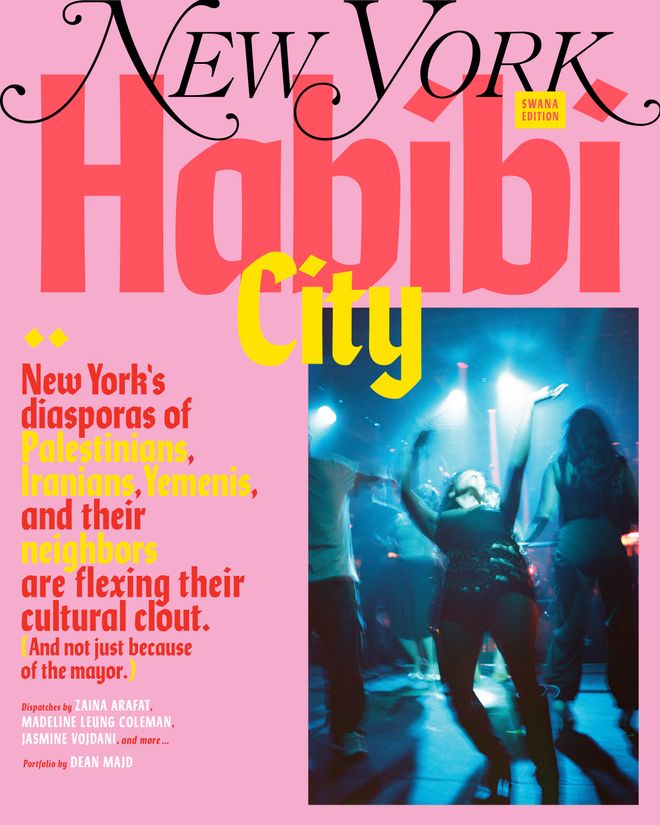
Habibi City
See All
We spoke to five of the families who gave the city an appetite for Arab food. A few you may know, like the Sahadis, who still draw third-generation regulars to their grocery store with jars of green-gold olive oil and freshly prepared kibbeh 130-odd years later. Or the Almontasers, whose extended family once owned some half-dozen restaurants near Atlantic Avenue; Yemen Café is the lone survivor. Here, their descendants rifled through old boxes to unearth family photos and take us back to the early days.
The Sahadis opened their first shop on Washington Street in Lower Manhattan in 1895 before moving to the current location on Atlantic Avenue in 1948.
A lot of business was done over coffee in the back room. People would come in and have coffee with my grandfather and then decide what they wanted. It was more like a souk than a typical supermarket. Nobody left in the morning without coffee, and in the midday without tea, and in the evening without arak. That was just the way. If you knew my grandfather, you came in the back. — Christine Sahadi Whelan
The original Sahadi’s on Washington Street in Manhattan, 1899.
The Bordays started some of the city’s first falafel shops in the late 1960s. They would open carts, a truck, and more Pierre’s Falafel storefronts, one of which they left to the Chaters, who went on to open Mamoun’s.
When we opened my father’s falafel shop, the concept of vegetarianism had just started to catch on. There was one Jewish kosher place that was more of a pizza shop, and it wasn’t anything special, but we would go there because it was the only place we could find falafel. Most Americans didn’t even know what a chickpea was. But my parents spent whatever money they could scrounge up and converted one of the very first Hondas that came to America into our first truck — it was the tiniest of cars, and they ripped out the interior so my father could make falafel in the back. There was this voluptuous belly dancer painted on the side of the truck with a phrase like “Healthy, Tasty, and So Sexy.” Business wasn’t great until he found a spot in front of Hunter College and then it became kind of an institution for students. — Noel Borday
Pierre’s Falafel cart on Wall Street, 1980.
The Chaters opened Mamoun’s Falafel on Macdougal Street in 1971.
My dad, Mamoun, has always been really good with numbers. In order to go into the food business, he made a list of all of his expenses, and he realized his biggest expense outside of rent was food, so he thought, Well, if I open up a restaurant, that’s taken care of for me. We all grew up at Mamoun’s. I started working there when I was 10. The store is at 119 Macdougal Street, and we lived at 95 Macdougal, and my mom would make a tray of baklava upstairs, and we’d have to bring it down. They couldn’t afford to hire workers at first, so when they opened, my dad would work one shift, my mom would work the other shift, and my dad would go work somewhere else to make more money. Then he would leave to sleep for six hours and do it all over again. I remember the day when a line started forming and my mom freaked out. We ran down the street to find my dad, who was working at some Armenian deli, and he ran back, and from that point on, he said, “All right, I think we’ve got something here.” And the odd jobs started trickling away. — Galal Chater
Azzat Chater, Galal Chater’s uncle, behind the counter at Mamoun’s, 1970s.
The Almontasers opened Almontaser Restaurant in 1973 and ran multiple restaurants along Atlantic Avenue.
My uncle Nasser opened Almontaser Restaurant. Atlantic House, run by my father’s cousin Mohamed, came around the same time. I believe Nasser had been involved with Atlantic House first, then left to open his own restaurant. Near East was more of our cousins, and cousins of cousins, a few partners between them. Adnan was run by another one of my father’s brothers. And the Moroccan Star, owned by Ahmed Almontaser and two of my father’s cousins, was where I had my wedding in 1980. Many of them started as busboys and dishwashers, learned the business, learned English, became cooks, saved their money, and then opened their own places. Each restaurant had something different people gravitated to; Nasser was famous for his spinach sauce and chicken. For years, when people recognized my last name, they’d say, “We’ve never had spinach sauce like his ever again.” — Dr. Debbie Almontaser
Almontaser Restaurant on Court Street, 1970s.
The Alsubais, relatives of the Almontasers, opened Yemen Café in 1986.
The first person in our family to come here from Yemen was my uncle Muhamed, who arrived in 1962. We knew a little bit about America because people from our village had been on Atlantic Avenue since 1890. By the time my dad, Yahya, arrived in 1978, my uncle already owned Adnan, a restaurant down the block that served Mediterranean food. There was Almontaser Restaurant and Near East — there were a lot of restaurants around Atlantic Avenue back then owned by Yemenis but selling mostly Mediterranean food. My dad was about 18 when he opened Yemen Café with his partner, Muthanna, who was a chef in the World Trade Center before deciding to open a restaurant. The neighborhood had a great Yemeni population, and everyone knew each other. Everything started to change around 2008, when the economy crashed. There was a lot of development, and new people started moving into the neighborhood. Now there are only five of us left standing: Yemen Café, Sahadi’s, Damascus, Malko, Oriental. — Mahmood Yahya Alsubai
Akram Nassir, Yahya Alsubai, and their family, 2008.
Photographs by The New York Times, Courtesy of the subjects

