Google recently confirmed it has begun testing agentic hotel booking within AI Mode for a limited number of U.S. users. The announcement has generated a lot of discussion throughout the travel industry, but the implications extend well beyond another booking feature.
Here are the five things hoteliers should know right now:
1. This is Google’s response to the rise of AI search
Over the past year, many in the industry have questioned whether travelers will begin planning trips in ChatGPT, Perplexity, Claude, and other AI assistants instead of Google Search.
This announcement suggests Google has no intention of giving up that position.
Rather than asking users to switch to a separate AI application, Google is embedding AI directly into Search through AI Mode and extending it all the way through the booking journey.
The goal isn’t simply to answer travel questions. It’s to keep travelers inside Google’s ecosystem from inspiration to transaction.
Unlike Google, which is actively testing an agentic hotel-booking experience and developing lodging-specific commerce infrastructure through UCP, OpenAI has recently shifted away from making ChatGPT the native transaction layer for travel. ChatGPT remains a powerful discovery and planning interface, but its current model relies more heavily on travel partners, such as Booking.com and Expedia, to provide inventory and complete bookings. Google’s recent announcement shows a prioritization of agentic commerce, while OpenAI has deprioritized native checkout as its primary travel-commerce model in favor of app-based, partner-managed fulfillment.
What should hotels understand about Google’s agentic test?
- Google is bringing AI-powered planning and booking into the search experience travelers already use.
- Rather than requiring travelers to adopt a separate AI tool, Google can retain the search, comparison, and booking journey within its own ecosystem.
- This reinforces that AI search is likely to complement and reshape traditional search behavior rather than immediately replace it.
- Hotels should expect travel research to become more conversational, personalized, and action-oriented.
2. Google is trying to own discovery – not become an OTA
Google has repeatedly stated it does not intend to become an online travel agency. Instead, its vision is to help travelers discover and compare options while allowing booking partners to complete the transaction and handle servicing.
Whether that strategy evolves over time remains to be seen, but it’s an important distinction.
For hotels, this means existing distribution partners and booking engines remain central to the booking process.
What are the key takeaways for hotels regarding how Google wants to handle agentic bookings?
- Google’s stated role is to help travelers find, compare, and select options, while booking partners complete the reservation and handle servicing.
- Hotels’ existing booking engines, CRS providers, metasearch partners, and OTAs remain important parts of the transaction path.
- The major question is not whether Google becomes an OTA; it is which partner’s offer, rate, and content Google chooses to surface. Make sure you are focused on optimization.
- Hotels should continue prioritizing direct-booking readiness while maintaining accurate, competitive distribution across key partners.
3. Connectivity is becoming a competitive advantage
Perhaps the most important technical announcement is Google’s Universal Commerce Protocol (UCP), which enables AI agents to complete transactions without sending users to another website.
That means booking engines, CRS providers, and distribution platforms will increasingly need to expose inventory, pricing, policies, and payment workflows in ways AI systems can consume.
Hotels with strong connectivity will be better positioned as AI-powered commerce continues to evolve.
What are key takeaways for hotels when it comes to agentic connectivity?
- Agentic commerce for hotels depends on systems being able to share current availability, rates, room details, policies, payment information, and booking confirmation data.
- Booking engines, CRS providers, channel managers, and other connectivity partners will play an increasingly strategic role in making sure hotels are eligible.
- Hotels with outdated, fragmented, or inaccurate feeds may be less likely to appear correctly, or at all, in AI-powered booking experiences.
- Inquire with your technology partners about their roadmap for Google’s Universal Commerce Protocol, AI booking integrations, and agent-referred booking reporting. Are they focused on AI agent readiness?
4. AI changes what “being discoverable” means
For years, hotels have focused on ranking well in search results and driving clicks to their websites. As AI becomes part of the booking journey, discoverability expands beyond rankings. Hotels will increasingly benefit from accurate rates, rich property information, structured amenities, policies, reviews, and high-quality content that AI can confidently interpret.
What are key takeaways for hotels to remain discoverable in the new agentic environment?
- Traditional rankings and clicks still matter, but AI systems must also be able to understand and trust the hotel’s information.
- Complete room descriptions, amenity details, accessibility information, guest policies, fees, packages, photos, and reviews will carry more weight in the decision path.
- Hotels should make it easy for an AI to answer high-intent questions, such as whether parking is available, which rooms sleep a family of four, or whether the property is walkable to a local attraction.
- Consistency matters: the same property facts should align across the website, booking engine, Google Business Profile, hotel metasearch feeds, OTAs, and CRS.
5. This is an early test – not a complete transformation
Google describes this as a limited U.S. test, and many details—including how broadly it will roll out and exactly how bookings will be processed, remain unknown. That means hotels don’t need to overhaul their digital strategy tomorrow. However, the direction is becoming clear: AI is moving beyond helping travelers research hotels and toward helping them complete bookings.
What this means for hotel marketers:
- The fundamentals haven’t changed – optimizing for visibility (similar to today’s Map Pack and Local SEO) will still matter to win in this new agentic marketing environment
- Hotels still need compelling creative, strong paid media, quality websites, competitive pricing, and excellent guest experiences.
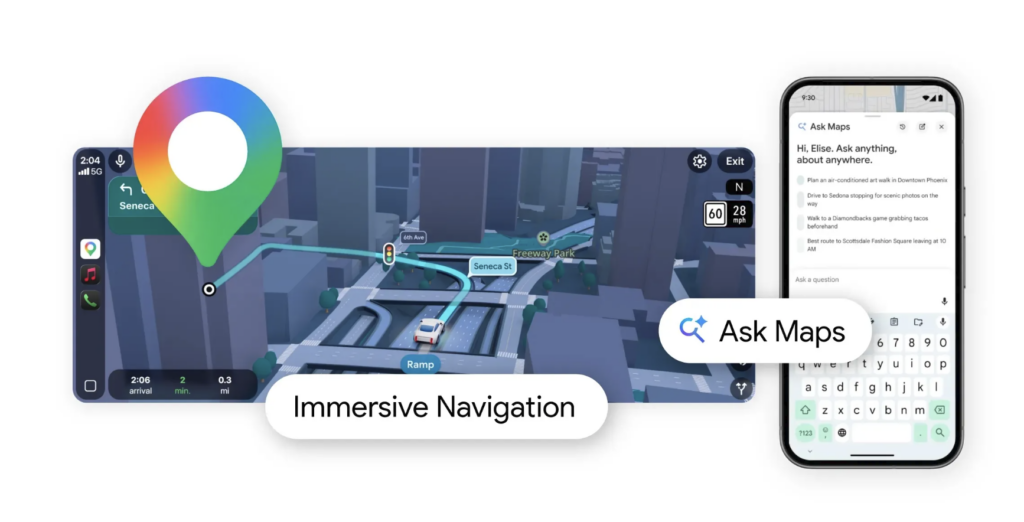
- Google continues to push towards feed-based campaigns – the future of hotel marketing visibility and conversion will rely on adoption of connected feeds such as hotel metasearch. The best example of this in Skift’s article was the new “Ask Maps” feature (in addition to longstanding hotel metasearch ads). Our take: this will expand to additional ad placements and channels sooner rather than later; make sure you’re building a clean foundation now.
- Data architecture and cleanliness remain vital to how your hotel can prepare for an agentic marketing future. Make sure you’re leveraging a hospitality data platform to turn insights into better optimization decisions to strengthen authority
- Reviews and photos move further into the transaction path. Because the agentic flow is designed to surface reviews and room photos directly inside the booking decision (not just on a listing page), review management and visual content quality are now closer to a direct revenue lever than a reputation exercise.
- Hotel content must become decision-ready. Consider calling out content that resolves the questions a traveler asks conversationally: “Is the pool heated year-round?”, “Which room accommodates two adults and two children?”, “Can I walk to the convention center?”, “Are resort fees included?”, and “Which rooms have a balcony?”
- Measurement is becoming a bigger blind spot as reservations move away from click-based attribution paths. Current reporting from Google and other agentic providers is lacking – without continued expansion from Google, Bing, and other agentic platforms with enhanced reporting, it will be even harder to attribute bookings to channels and campaigns.
What’s changing is the way travelers interact with those assets. As AI becomes another interface for discovering and booking travel, structured data, modern connectivity, and high-quality content will become increasingly important components of a successful digital strategy.
The travel industry has spent the last two years asking whether AI would replace search. Google’s answer appears to be something different: make AI the future of search itself.
{
“@context”: “https://schema.org”,
“@type”: “FAQPage”,
“mainEntity”: [{
“@type”: “Question”,
“name”: ” Is Google’s agentic hotel booking available to all travelers and hotels?”,
“acceptedAnswer”: {
“@type”: “Answer”,
“text”: “
SEO helps hotels and resorts capture high-intent travelers earlier in their booking journey by improving visibility in organic search results. By aligning content with traveler intent, optimizing site performance, and targeting the right keywords, properties can reduce reliance on OTAs and increase direct bookings while improving profitability.
”
}
}, {
“@type”: “Question”,
“name”: “Will Google complete the reservation or send travelers to a booking partner?”,
“acceptedAnswer”: {
“@type”: “Answer”,
“text”: “
The answer depends on the product experience. Google’s agentic hotel-booking test has limited public detail, so Google has not clearly explained every booking handoff or completion flow.skift
However, Google’s UCP for Lodging framework is designed to support direct, in-flow hotel reservations on Google AI surfaces such as AI Mode in Search. That does not necessarily mean Google becomes the seller of the reservation: the hotel, OTA, or other participating booking partner can remain the party completing and servicing the transaction.developers.google
”
}
}, {
“@type”: “Question”,
“name”: “Will hotels still be able to drive direct bookings?
“,
“acceptedAnswer”: {
“@type”: “Answer”,
“text”: “
Yes, at least under Google’s stated UCP model. Google says the business implementing UCP remains the merchant of record and retains its customer relationship, data, and post-booking experience, which creates a path for an on-brand booking engine to power an AI-assisted direct reservation.developers.google
That said, direct booking will increasingly depend on technical eligibility coupled with foundational optimization aimed at visibility, reviews, and reputation. A hotel’s rates, availability, room content, policies, images, and payment/booking workflow must be accurate and accessible enough for the AI experience to recommend and transact on its offer.
”
}
}, {
“@type”: “Question”,
“name”: “How will agentic bookings be tracked in analytics and attributed across channels?
“,
“acceptedAnswer”: {
“@type”: “Answer”,
“text”: “
This is one of the major concerns and blind spots hotel marketers should be aware of with agentic booking. There is not yet a standard public reporting model for Google’s limited hotel-booking test. Hotels should not assume that traditional organic, paid-search, metasearch, referral, or direct-channel reporting will fully identify AI-assisted bookings.skift
”
}
}, {
“@type”: “Question”,
“name”: “Will hotels have to pay for placement or commission?
“,
“acceptedAnswer”: {
“@type”: “Answer”,
“text”: “
Google has not publicly disclosed the commercial terms for its limited agentic hotel-booking test, including whether participation, placement, clicks, or completed bookings will carry a fee.skift
”
}
}, {
“@type”: “Question”,
“name”: “How does Google compare with ChatGPT travel booking?
“,
“acceptedAnswer”: {
“@type”: “Answer”,
“text”: “
Google is building agentic booking into surfaces where travelers already search and compare hotels, including AI Mode and Maps. Its UCP for Lodging initiative is designed for direct, in-flow reservations while allowing the participating business to remain merchant of record.developers.google
ChatGPT’s current travel approach is more partner-app based. For example, Expedia can show live lodging results, pricing, availability, and visuals within ChatGPT, then send the traveler to Expedia to complete the reservation. OpenAI also has an Agentic Commerce Protocol for embedded checkout, but it states that participating merchants, not OpenAI, validate and accept orders, process payments, and remain merchants of record.
”
}
}, {
“@type”: “Question”,
“name”: “What data should a hotel audit first?
“,
“acceptedAnswer”: {
“@type”: “Answer”,
“text”: “
Begin with the data most likely to determine whether an AI can confidently recommend and book the property:
- Real-time rates, inventory, minimum-stay rules, taxes, mandatory fees, deposits, and cancellation policies.
- Property facts, amenities, accessibility details, pet policies, parking, dining, pool/spa information, and location attributes.
- Room-level names, occupancy, bed types, images, inclusions, and differentiators.
- High-quality photos, current reviews, accurate business-profile information, and consistent facts across the hotel website, booking engine, Google surfaces, metasearch, OTAs, and CRS.
- Offer and loyalty logic, including member rates, packages, promo rules, and ancillary products.
This is consistent with both Google’s emphasis on instant booking through UCP and OpenAI’s commerce requirements for refreshed structured data such as descriptions, pricing, inventory, media, and fulfillment details.
”
}
}]
}
Frequently asked questions about Google Agentic Booking
SEO helps hotels and resorts capture high-intent travelers earlier in their booking journey by improving visibility in organic search results. By aligning content with traveler intent, optimizing site performance, and targeting the right keywords, properties can reduce reliance on OTAs and increase direct bookings while improving profitability.
The answer depends on the product experience. Google’s agentic hotel-booking test has limited public detail, so Google has not clearly explained every booking handoff or completion flow.skift
However, Google’s UCP for Lodging framework is designed to support direct, in-flow hotel reservations on Google AI surfaces such as AI Mode in Search. That does not necessarily mean Google becomes the seller of the reservation: the hotel, OTA, or other participating booking partner can remain the party completing and servicing the transaction.developers.google
Yes, at least under Google’s stated UCP model. Google says the business implementing UCP remains the merchant of record and retains its customer relationship, data, and post-booking experience, which creates a path for an on-brand booking engine to power an AI-assisted direct reservation.developers.google
That said, direct booking will increasingly depend on technical eligibility coupled with foundational optimization aimed at visibility, reviews, and reputation. A hotel’s rates, availability, room content, policies, images, and payment/booking workflow must be accurate and accessible enough for the AI experience to recommend and transact on its offer.
This is one of the major concerns and blind spots hotel marketers should be aware of with agentic booking. There is not yet a standard public reporting model for Google’s limited hotel-booking test. Hotels should not assume that traditional organic, paid-search, metasearch, referral, or direct-channel reporting will fully identify AI-assisted bookings.skift
Google has not publicly disclosed the commercial terms for its limited agentic hotel-booking test, including whether participation, placement, clicks, or completed bookings will carry a fee.skift
Google is building agentic booking into surfaces where travelers already search and compare hotels, including AI Mode and Maps. Its UCP for Lodging initiative is designed for direct, in-flow reservations while allowing the participating business to remain merchant of record.developers.google
ChatGPT’s current travel approach is more partner-app based. For example, Expedia can show live lodging results, pricing, availability, and visuals within ChatGPT, then send the traveler to Expedia to complete the reservation. OpenAI also has an Agentic Commerce Protocol for embedded checkout, but it states that participating merchants, not OpenAI, validate and accept orders, process payments, and remain merchants of record.
Begin with the data most likely to determine whether an AI can confidently recommend and book the property:
- Real-time rates, inventory, minimum-stay rules, taxes, mandatory fees, deposits, and cancellation policies.
- Property facts, amenities, accessibility details, pet policies, parking, dining, pool/spa information, and location attributes.
- Room-level names, occupancy, bed types, images, inclusions, and differentiators.
- High-quality photos, current reviews, accurate business-profile information, and consistent facts across the hotel website, booking engine, Google surfaces, metasearch, OTAs, and CRS.
- Offer and loyalty logic, including member rates, packages, promo rules, and ancillary products.
This is consistent with both Google’s emphasis on instant booking through UCP and OpenAI’s commerce requirements for refreshed structured data such as descriptions, pricing, inventory, media, and fulfillment details.
The post What Google's Agentic Booking Test means for hotels appeared first on GCommerce Solutions.
