Key Aspects:
- The Áak’w Landing cruise terminal project for downtown Juneau has downsized due to escalating costs.
- Revised plans still cover all the proposed features of the new facility but at a smaller scale to control those costs.
- A new timeline has not yet been announced and it is hoped the terminal can still open in 2028.
The planned downtown cruise terminal in Juneau being developed by the Huna Totem Corporation has been scaled back to less than half of the original plans, with various costs cited as the overarching reason for the adjustment.
The private dock’s facilities will now encompass approximately 18,000 square feet instead of the originally projected 50,000 square feet designed for Áak’w Landing.
In the initial phase of construction, just 9,868 square feet of interior space will be developed. The remaining 7,960 square feet is now planned for a future phase with an unknown timeline.
The revised design does include all the original intent of the development, including a welcome center for visitors, a cultural center honoring local and regional heritage, retail space, waterfront dining, and a seawalk extension.
What has been eliminated are the multi-story buildings (which will now be just one story), a much larger deck, and a more extensive seawalk, but the key features of the project are preserved.
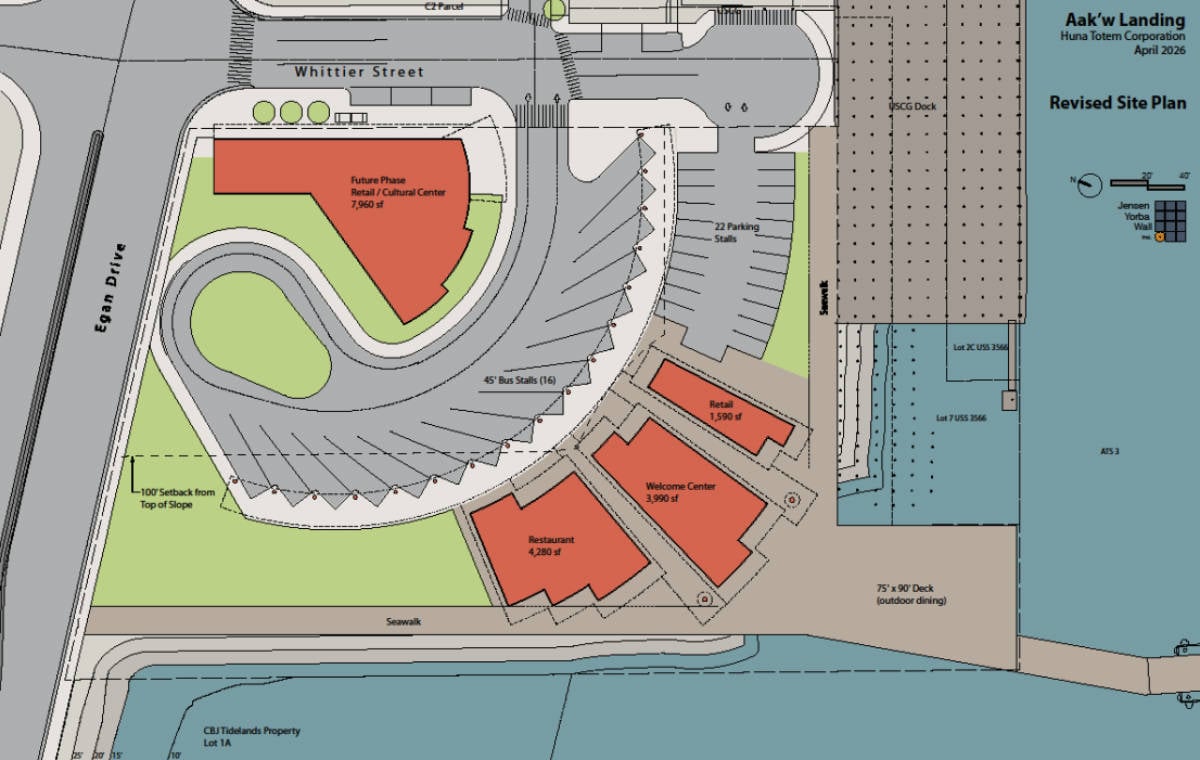
“When you look at that original drawing the plan had been to build to the full property line, which would have meant a lot more of that deck, buildings and seawalk would have been out over the water on pilings,” Susan Bell, Huna Totem’s vice president of strategic initiatives, told the Juneau Independent.
“We just scaled back to the property as it exists now and scaled the buildings down, and still feel it’s going to be an excellent guest experience and an excellent place for residents.”
Parking for the property has also been revised and will now all be above ground rather than include underground spaces, while pedestrian access will be at street level instead of via escalators. The amount of bus parking remains unchanged, as this would be critical for servicing tour groups for shore excursions, particularly for larger cruise ships.
Spiraling Costs Forced Revised Plans
When initially announced in 2023, the projected cost for the project was $150 million. Due to some delays and appeals, the cost for the original design is now expected to reach more than $250 million, more than a 66% increase.
Extra costs are being attributed to tariffs imposed on materials over the past three years, which have upped the cost of steel and other essential construction materials.
Read Also: Juneau Cruise Port, Alaska – Overview and Guide
A geotechnical analysis of the part of the project over the water and beyond the shoreline has also noted that costs could be prohibitive. That analysis also showed that the much larger buildings at the center of the project added more weight that could also impact construction costs due to the need for deeper pilings.
With the buildings scaled back to a more manageable size and less overwater development, Huna Totem hopes to keep the costs to the initial budget of $150 million.
When Would the Revised Project Be Open for Cruises?
Bell notes that Huna Totem still hopes the first phase of the project will be complete and ready to welcome guests for the 2028 Alaska sailing season. With the revised project, that may yet be possible.
Because the changes to the original design are now so extensive, however, the overall permit for the project must be reviewed and approved again. The revised plan has been submitted to the Borough Assembly for consideration for modifications to the conditional use permit first granted in July 2023.
Should the modified plan be approved, there may yet be public hearing periods and other discussions that could potentially delay the hoped-for 2028 opening.
Cruise Hive has previously reported on different opposition to the plan, including a citizen petition fighting against ever-larger and more numerous cruise ships in Juneau.
Overall, the revised dock still offers value for Juneau residents by reducing local traffic congestion, extending the scenic seawalk, creating new downtown parking and a public park, and offering educational and economic opportunities.


