Kim is set to open Bar Chimera on April 18.
Photo: Clemens Kois
In the nine years since he opened Cote, the Flatiron District mash-up of an American steakhouse and a Korean-barbecue joint that remains jammed each night, Simon Kim has become one of the city’s true empire builders. He is New York’s most famous purveyor of caviar-topped chicken nuggets with his follow-up, Coqodaq, and has expanded Cote to Miami, Singapore, and Las Vegas. Despite the growth, his ambition has not dimmed, and he has returned his focus to New York because this is where he wants to serve the best martini in the world.
Kim’s latest project is his grandest yet. “This is my Sistine Chapel,” he says, looking up at the 60-foot-high ceilings of the arcade at 550 Madison, a skyscraper designed by Philip Johnson and John Burgee that once housed the Quilted Giraffe. Here he has built, with the help of restaurant designer David Rockwell, Bar Chimera, a three-bar beast with each one dedicated to a single specialty: wine, whiskey, or the martini. “The best martini bar in the world belongs in New York City,” Kim says.
Accomplishing that goal isn’t as straightforward as getting the drink’s temperature colder than the martinis at Dukes in London or finding better olives than Musso & Frank in L.A. If Bar Chimera ends up topping the list of best martinis across the globe, it will at least partly be due to the same reason New York makes the best pizza dough in the world: water. For some of the house martinis, pre-batched and served from the freezer, Kim’s team “tested more than 50 types of water, pH levels, mineral content, and structure to finally come up with the perfect water for your martini,” Kim says. “We created a proprietary water that is first filtered for purity, then remineralized and loaded with electrolytes to restore essential minerals, even more so when drinking.”
Lofty ambitions don’t come cheap, and likely neither will a night out at 550 Madison. The space justifies high prices: Bar Chimera’s centerpiece is a massive pine tree stretching toward the ceiling. Kim — whose family moved from South Korea to Long Island when he was 13 in the 1990s — says the pine tree is important in Korean culture. This one, over 20 feet tall and dwarfing two other pines mounted in the center of a custom marble fountain, is American. Kim notes the clear metaphor isn’t an accident. “As a restaurateur, I found out that I never want to be the best replica of what exists in New York or Korea,” he says. “We want to create what is uniquely New York — different roots but deep respect to all of its cultures.”
Great restaurateurs have defined this city’s tastes for as long as anyone can remember. While Kim, who is still in his early 40s, is at least a couple of decades away from reaching the same level of influence as Keith McNally or Nobu Matsuhisa, his career so far has put him on a path to be the kind of operator whose places will still be around — and full — years from now. The success hardly happened overnight. Kim grew up working in the restaurant industry, starting with bussing tables and making drinks in places owned by his parents. The industry made sense to him as a good career option, so he worked his way up the ladder and into jobs with some of the premier hospitality groups in the U.S. Perhaps as a result, he is the sort of owner who obsesses over details and knows how to ensure his places operate efficiently. This, most likely, is how he came up with the Ninja Tunnel.
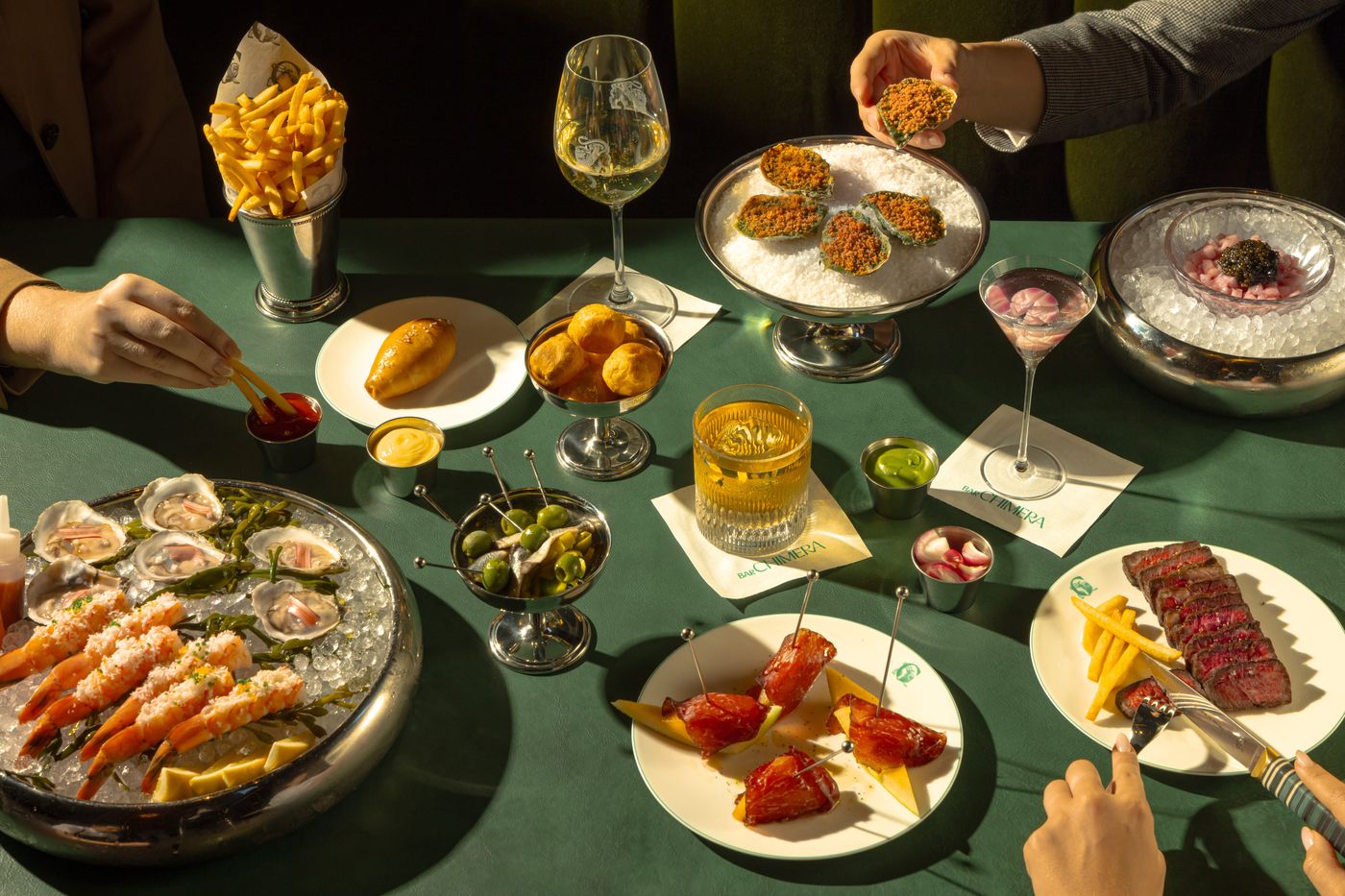
A spread at Bar Chimera.
Photo: Gary He
Kim calls the upstairs space “the polite place.” In the coming months, it will grow to include Sushi Yoshitake, chef Masahiro Yoshitake’s omakase den. Meanwhile, the subterranean rooms are dark “to a point where an executive was like, ‘This looks like too much of a party place,’ ” Kim says. “You feel a little bit of discomfort, even, because there’s a DJ and whatnot.” Here, bathed in the red glow of a dry-aging room that takes up the entire back wall of the bar on the lower level and serves as an entryway to a new Cote, Kim shows off a hidden door through a hidden hallway that’s totally out of the line of sight for somebody who might be enjoying a martini or Merlot at the bar. This is where dishes will be ferried through the otherwise crowded, dark restaurant to appear at tables like magic. “I’m proud of our ability to design something that’s not just really beautiful but also hyperfunctional,” he says. Even though customers may never notice this part of the operation, Kim thinks the Ninja Tunnel, as he named it, is as important to the 550 Madison experience as the wine list or sound system. The part customers will see, the entire entryway to Cote, came from a different inspiration: Kim asked Rockwell Group to model this passageway after the caves that give way to the treasure-filled grotto in The Goonies. “There’s the pirate ship and all the vegetation everywhere,” he says. “It was the most bonkers, immersive experience. I shared that inspiration, and they delivered us exactly that.”
Rockwell — the group — was first brought on to redo the amenity levels of the building after it had been purchased by the Olayan Group in 2016. Rockwell — the person — had worked with Kim previously (on Coqodaq and Cote Las Vegas), but he also had experience bringing a restaurant to life in a Johnson-designed building with Vong, a Jean-Georges Vongerichten project in the Lipstick Building, back in 1992. At the time, not wanting to draw the ire of an old postmodern master, Rockwell reached out to Johnson and showed him the plans. Nearly 30 years later, working on 550 Madison, he heard there was going to be a ground-floor restaurant. “There’s only two or three times in my life where I’ve said, ‘I want to get involved in that project,’” he explains, trying to remember other examples besides “the original Nobu.” He says the entire project in this building has been “a full-on labor of love — a chance to create a new midtown destination that, in some ways, is the result of my 45-year love affair with NYC: its restaurants, public spaces, and energy.”
Walking through the space wearing a double-breasted Ralph Lauren Purple Label blazer and a Yankees hat, Kim shows me one of the chandeliers; each were cut and assembled by hand. “There’s like two layers of light,” he says, “the ring light and this kind of star explosion of the bulbs inside.” After Cote’s success, Kim could have built a fine living opening outposts in high-earner destinations around the world. He still could, but for now he wants this project to be his legacy — and for New York to embrace his vision. “It doesn’t exist anywhere else in the city,” he says, “this level of architecture, this level of grandiose.”
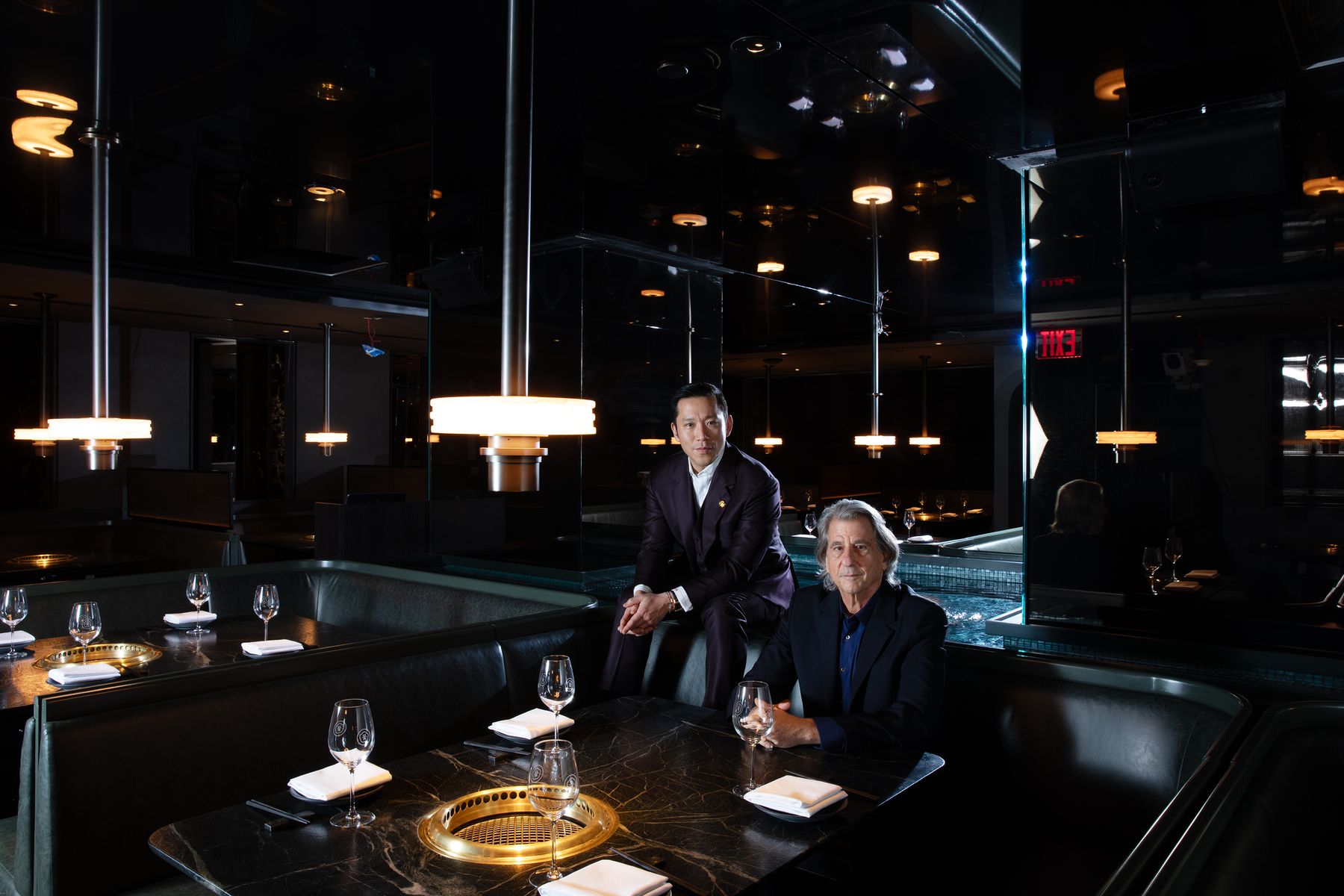
Kim and David Rockwell.
Photo: Clemens Kois
See All

