Improving AI search visibility: A practical action guide for your hotel
We’ve all heard it by now. AI search is the future, and your hotel’s discoverability is becoming increasingly dependent on visibility within AI search results. But what can you do about it?
Like many other marketing channels, the factors that impact AI search visibility fall under a variety of categories and optimizations, requiring a comprehensive multi-channel strategy to achieve success. But don’t let that scare you! While AI search visibility isn’t an exact science, there are plenty of things you can do to improve your hotel’s standings.
Here’s our list of the most important actions to take when trying to improve your hotel’s AI search visibility.
At a glance
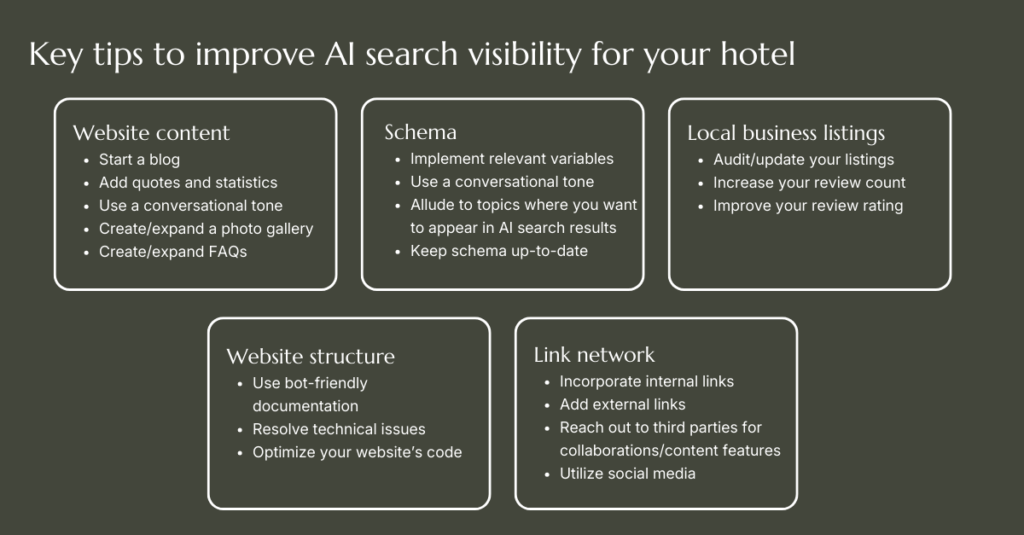
There are 5 main categories where your hotel can optimize for improved AI search visibility:
- Website content
- Local business listings
- Schema
- Website structure
- Link network
We’ll dive into more detail with the rest of this article, but here are our top recommendations for each category:
Website content
AI models prioritize sources with a large volume and wide variety of content. Websites that cover a range of topics, and websites with a large amount of information to source from, are more likely to appear in AI search results.
AI models also prefer page content that is reliable and thoroughly researched. Including links, quotes, and statistics into your web content can improve your website’s credibility, and therefore your hotel’s AI search visibility.
The contents of your website matter too. AI models prefer conversational, simple language to better align with their more casual search responses. They also prioritize easy-to-digest content, with a special preference towards high-demand items such as photos and frequently asked questions.
Here are the immediate steps you can take to improve your hotel’s website content:
- Start a blog to broaden your website’s scope and page count.
- Cover topics around your hotel’s offerings and special features, things to do in the area, local events, and anything else that potential guests might be searching for.
- Add quotes and statistics to your webpages.
- For hotels, guest reviews and third-party articles are a great source of AI-friendly quotes.
- Incorporate a more conversational tone into your content.
- If formal language is a strong part of your hotel’s branding, consider simplifying some sentences to emulate a more casual tone without sacrificing brand voice.
- Create or expand a photo gallery.
- Prioritize high-quality imagery that features the most notable and unique aspects of your hotel. This may include dining options, waterfront views, or even amenities such as a pool or hot tub.
- Create or expand FAQs for your hotel.
- Develop FAQs based on actual guest feedback and your own AI searches to determine what information your hotel’s potential guests are really looking for.
- A standalone FAQ page is most impactful and may help your hotel’s visibility in traditional search, along with AI search results.
- It’s also beneficial to add a set of 3-5 FAQs on topically relevant URLs. For example, add a few rooms-related questions to your hotel’s “Accommodations” page or include restaurant-related FAQs on the “Dining” page.
Local business listings
When recommending businesses, AI models tend to rely heavily on local listings such as Google Business Profile. Both business information and customer sentiment from these listings are used by AI models to offer the best options to users within AI search results.
Therefore, it’s incredibly important to optimize and maintain your hotel’s local listings over time. The following tactics are likely to increase your hotel’s AI search visibility, especially when completed on an ongoing basis:
- Audit and update your hotel’s local business listings to ensure accurate and up-to-date information.
- Be sure to prioritize listing accuracy on the following websites:
- Google Business Profile
- Tripadvisor
- Yelp
- Sign up for a local listings management service to add and update your business information across hundreds of websites simultaneously, including those listed above. Examples of these services include:
- Yext
- SEMRush
- Moz Local
- Be sure to prioritize listing accuracy on the following websites:
- Increase your hotel’s review count across various websites. Potential ways to generate reviews include:
- Post on-property signage asking guests to leave a review.
- Encourage guests to leave a review within post-stay emails or receipts.
- Provide direct review links and QR codes to make the review process seamless for guests.
- Be cautious with incentives such as discounts, loyalty points, or giveaways based on reviews. This may violate platform guidelines or terms of service, leading to penalties for your hotel’s listings.
- Improve your hotel’s review rating across various websites. To achieve this, try the following:
- Respond to your hotel’s reviews. For the most significant impact, follow the best practices outlined in our article on How to respond to Google reviews.
- Provide an easy way for guests to offer negative feedback to your hotel directly. If guests can privately address issues with your staff or on your website, this may bypass the need to post a public negative review.
- Take negative feedback from guests into consideration, and make an effort to solve recurring issues within your hotel’s operations.
Schema
Schema variables outline your hotel’s offerings and web content in a way that’s easy for AI models to read and digest. By incorporating well-structured, clean schema into your website, you increase the chances of showing up within AI search results.
Keep the following in mind when implementing schema variables:
- For hotels, the following schema types are most beneficial:
- Local Business schema outlines information about your hotel, dining establishments, and other offerings such as spas and golf courses.
- Product schema can be used to describe room types, offers, and packages.
- FAQ schema is an important element for hotels, especially when used in tandem with an FAQ landing page on your website.
- Article schema highlights blog posts, press releases, and third-party buzz about your hotel.
- Where possible, incorporate a somewhat conversational tone and allude to topics where you want to improve AI search visibility. Similar to on-page content, highly relevant and easy-to-use schema variables increase your hotel’s likelihood of appearing in AI search results.
- Make sure to keep your schema variables up-to-date with the most recent information about your hotel.
Website structure
AI models are fairly efficient at reading website content and understanding code. However, a clean and optimized website structure reduces friction, making it easier for AI models to digest your content correctly and thereby increasing your AI search visibility.
For optimal performance within AI search results, consider these website elements:
- Add bot-friendly documentation to your website, including the following:
- Implement an llms.txt document, used by Large Language Models (LLMs) to find your most important and relevant content.
- Create a sitemap.xml file outlining all URLs on your website for maximum discoverability.
- Highlight your sitemap.xml file in a robots.txt document so it’s easy for AI models to find.
- Resolve technical issues such as:
- Redirect 404 pages to land on live content.
- Update outdated and broken links to include up-to-date URLs.
- Remove and redirect outdated webpages to ensure fresh, accurate content.
- Minimize duplicate content across webpages, title tags, and meta descriptions.
- Optimize your website’s code, with a particular focus on the following:
- Utilize a clean, intuitive, sub-folder structure so navigation of your website is seamless.
- Ensure that website elements such as title tags, meta descriptions, and H1s are placed in the correct order and location of your code.
- Improve your website’s average page speed to reduce friction for AI models.
- The following tools may help you maintain your website’s technical health:
- Identify potential issues with your website’s structure using site audit and SEO crawling tools from SEMRush and Screaming Frog.
- Yoast SEO and RankMath offer creation and management features for llms.txt, sitemap.xml, and robots.txt files.
- The WordPress plugin Redirection can assist in cleaning up 404 pages, duplicate content, and outdated webpages.
Link network
Incoming links, outgoing links, and brand mentions associated with your hotel can improve AI search visibility by boosting website credibility, streamlining discoverability, and increasing mentions of your website within AI model databases.
To improve your hotel’s link network, consider the following:
- Incorporate internal links to other pages from your own website.
- For example, link to your restaurant’s landing page when discussing the establishment in your FAQ or Amenities list.
- Add external links to outside resources where applicable.
- Highlighting your hotel’s third-party awards, press features, and partnerships is an easy way to boost your external link count.
- Reach out to local businesses, blog owners, news sites, or even influencers to request a collaboration or content feature which includes a link to your website or otherwise mentions your brand.
- Oftentimes, collaborations involve both websites linking to each other, providing the extra benefit of increasing your own website’s external link count.
- Utilize your hotel’s social media to post blogs, press features, and other links to your website. Social media links still count towards overall link building.
Takeaways
Improving AI search visibility requires a well-rounded strategy across a variety of website elements and marketing channels. While no single change is likely to move the needle on its own, a number of small optimizations working in tandem will give your hotel the best chances of showing up in AI search results.
If you want to learn more about AI search visibility or you’re ready to get started, reach out to GCommerce today. We’d love to discuss your current AI search strategy and help set up your hotel for future success.
The post Improving AI search visibility: A practical action guide for your hotel appeared first on GCommerce Solutions.
