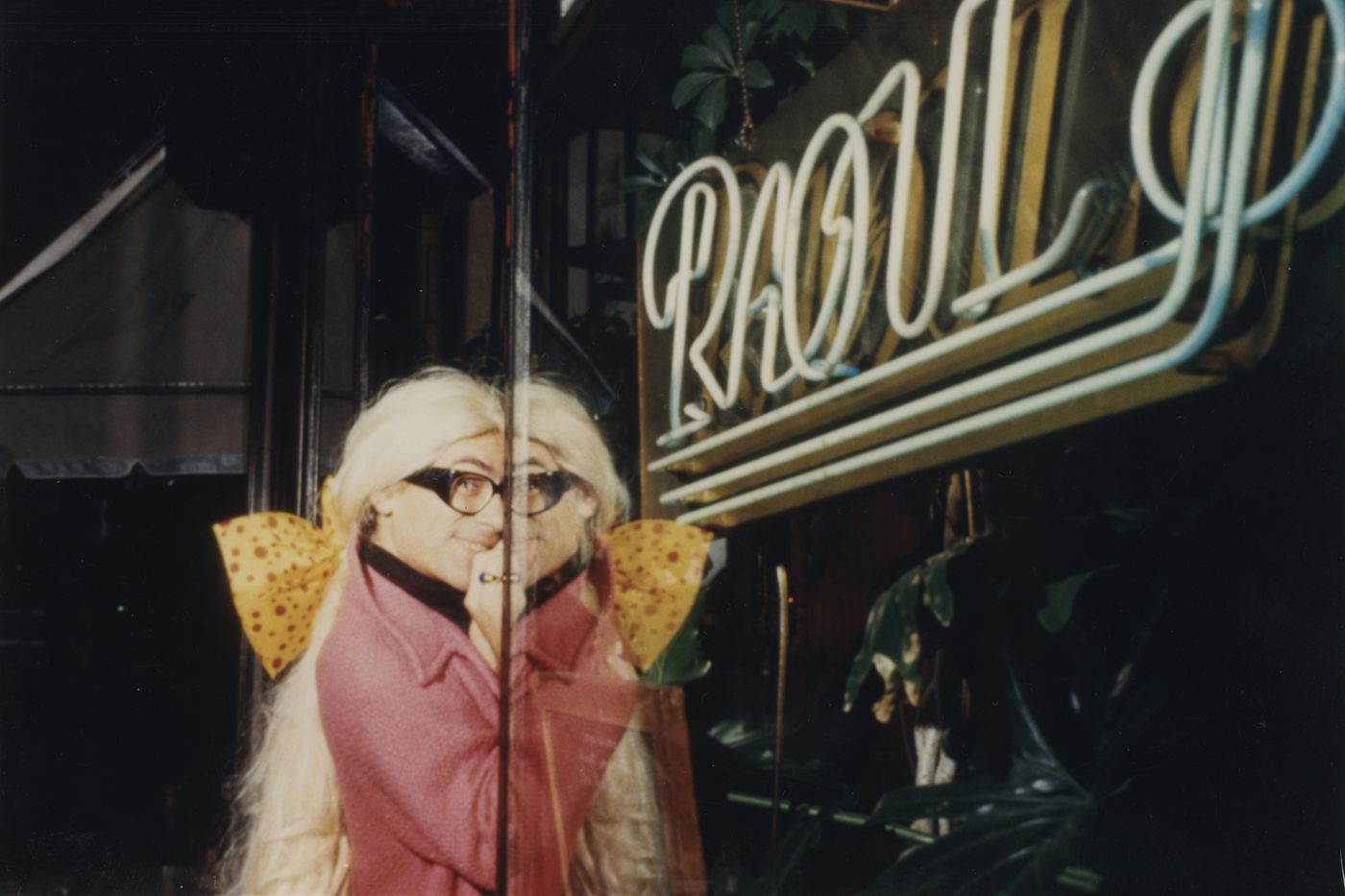
The famous Prince Street exterior.
Photo: Courtesy of Raoul’s
Raoul’s — “Restaurant Francais,” per its famous outside sign — is celebrating its 50th birthday. Inside the long, narrow room, with its pressed-tin ceiling, art-covered walls, and vertiginous spiral staircase promising ascension to the restroom, time seems to have barely passed. On the slate board, in that immediately recognizable French handwriting, the menu has remained largely unchanged (artichoke vinaigrette, steak au poivre, foie gras chaud) since an Alsatian filmmaker named Serge Raoul opened the spot in 1975. But of course, nothing stands still, especially not in Soho. The restaurant used to be filled with the artists who lived in the nearby lofts; now those lofts go for millions and many of the artists have passed away. Serge himself died last year at age 86. Today his son, Karim Raoul, himself a filmmaker, has become the guardian of the restaurant. On the eve of Raoul’s big 5-0 party — hosted by Chloe Sevigny, age 51 — Raoul sat down to discuss the magic of the room, the inescapable pull of their burger, and the impromptu burlesque performances that made the restaurant what it is.
Tell me about Raoul’s at 50.
The restaurant is going through a transition. It’s representative of the fact that old New York is slowly fading and entering into another era.
How would you characterize old New York, and how would you characterize the time into which New York is entering?
Old New York was a time when businesses were in control of what they were. Businesses like ours had an identity, and people came to visit those places because they liked that identity. They just accepted being in that world. Now, people are in control of what businesses become. The point being that back in the day, money wasn’t the only thing on your mind. You had a certain freedom to do what you wanted, to get together with your friends — or brother in the case of Raoul’s — open up a restaurant, and see how it goes. Things worked out, or didn’t work out, organically. These days, you just don’t have the ability to do that because you just can’t open any restaurant for less than a million bucks. You need to really be ready to do something, plan for it, get a bunch of money behind it, execute it, and then keep the public’s opinion in the back of your mind as to whether what the identity is going to work.
Along those lines, when you think about what Raoul’s was back in the ’70s and ’80s, one of the things that made it special is that there was this mix of artists from the neighborhood and the connection with French public television, where your father had worked as a filmmaker and sound guy before opening the restaurant. And I wonder if you feel like that mix is still possible as the financial realities of New York mean that it is hard to find a room full of creative people — not “creatives” — who can afford not only to live in New York but to eat out in it.
Raoul’s got lucky in the sense that all those people from the beginning grew as the restaurant grew. They became richer too. There was more money going around. Luckily for us, they kept coming back. So the restaurant grew with them. Now, 50 years later, those people are dying off. But we’re also lucky to have those people’s kids and grandkids who still come. The link is naturally fading. It’s like veterans from D-Day or something. But to answer your question, that scene is still happening, but just not in New York. We were the model for that, and I think that’s pretty cool.
Raoul’s is a very New York restaurant. In fact, the documentary you just made is subtitled “A New York story,” but there’s a fascinating pre-history of Raoul’s that begins in early 20th-century France. Tell me a bit about the pre-Raoul’s Raoul’s.
The first iteration of Raoul’s was in Altkirch, a small town in Alsace. My great-grandfather, a mailman, opened a little café across from a cement factory serving coffee and schnapps in 1937, the same year my father was born. A year later, when my great-grandfather died of heat stroke, my grandfather, a baker, took over. During the war he was conscripted to join the German army, captured by the Russians, and sent to prison. While he was in prison, his best friend — who had escaped to England and joined the army — returned to Alsace as part of the liberating force. My grandmother, who was taking care of the restaurant in his absence, fell in love with him and, shortly after my grandfather’s return, abandoned the family for Paris. My grandfather remarried, raised my father, and ran Raoul’s. Neither my dad nor Guy, his younger brother, wanted anything to do with the café. When he turned 17, my dad left for Paris to work for French television. Eventually he moved to New York and got a job with the U.N. Guy moved to New York in 1972. My dad opened Raoul’s a few years later, and I’m sure my grandfather was very surprised.
Did you think you were going to be involved in the restaurant?
No. Like my dad, I didn’t want to be in the business. Like him, I wanted to be a filmmaker. In fact, I was in Bali making a documentary when he had a stroke. That was in 2012. I came back to take care of him. But to take care of him was to take care of the restaurant. All of a sudden you look up and it’s 15 years later. History repeats itself.
That is the ballad of all middle-aged men: You look in the mirror one day and realize you’ve become your father.
Even when I started getting into Raoul’s again, I didn’t think this would be my path forever. I thought I would go back to making movies. After a couple years, I saw the writing on the wall, but I didn’t really mind it so much. It was very similar to making movies. The restaurant business and the movie business are very similar: They’re structured the same way. There’s a top of the line and a bottom line. There’s a creative aspect, but there’s also a big logistical aspect to it.
One of the reasons your dad took over this space, back in 1975, was because for years before it had been Luizzi’s, an Italian restaurant, and he was drawn to how cinematic it already was.
The restaurant is a movie set. Actually, it’s more like a theater set: It’s the same room where people come in every night. There’s also an energy to it. The first iteration of this space was a horse stable, and then it became a Portuguese dance hall, and then it was a string of Italian restaurants for a long time. Even those restaurants lasted 30 years, 40 years apiece. There was an energy that got built in here through the past 120 years that has become palpable. It just looks like a room that was from another time, and it’s hard to find rooms like that in New York.
It’s impossible to find rooms like that. Somewhere along the way, the chain of custody that keeps that spirit alive is broken. Of course, there are restaurants in former stables or speakeasies or in buildings where Basquiat once partied but, after a million-dollar renovation, they are at best homages. The thing about Raoul’s is that it isn’t an homage to itself. It just is.
My dad was smart enough to not touch the room, and it hadn’t been touched 30 years prior to 1975. You’re talking about a room that’s potentially been here for 120 years. To go through all those iterations of restaurants and nobody had ever said, “I think it’s time to rip out this tin ceiling” is very rare.
And yet the room isn’t what made Raoul’s Raoul’s. It wasn’t even just the customers. It starts with the maître d’. Tell me a little bit about Rob Jones, whose portrait still hangs by the coat check.
Something that has always been a little bit particular to Raoul’s is that it has never been an owner-centric restaurant. My father and I were very aware of the idea that it was probably not us who would be the point person in this room. It should be someone else. We needed somebody to represent the restaurant in the restaurant. It’s always been the people who have made it work. I know that’s sort of stupid to say that, but it’s true in every restaurant. I think Rob was our first iteration of that.
Do you remember him?
Rob? Yeah. He died in 1989; I was born in 1978. I remember him as a child., But each of the maître d’s bring their own character, and the place becomes defined by those people. For Eddie, it is his 47th year with us. When he started, he had ties to the Wall Street crowd. The nights he was working it became a sort of Cheers thing going on. When he wasn’t working, Philip was the other maître d’, and he was connected to the downtown art world because he was friends with Rob.
Rob Jones.
Photo: Courtesy of Pepe Diniz
It’s almost like the East Village Russian and Turkish Baths: There is a David week and a Boris week.
It’s exactly like that. And it brought in totally different people. And so it was cool because at the end of the day, they were all mixed together in the room, and everybody had their point person, but together they were all in the same thing. That’s one reason we’ll never get rid of the maître d’. Ever since they changed the rules with the tip pool, it’s been really hard for them to have the role that they used to have. The simple solution would just be to have a couple of hostesses, but then we’d lose the connection.
The maître d’ is like the central nervous system.
Yes. You don’t call Raoul’s to get a reservation — you call Eddie or you call Corin, or in the past you’d call Rob. You need a personal connection with the restaurant.
Rob was famous for his drag performances, descending down the spiral staircase dramatically. Are there still performances today?
A lot less than there used to be, because the staff too has changed and it was always through the staff that it happened. It was never like my father saying, “Okay, let’s get this burlesque act in here for a hundred bucks.” It was more someone who worked here and happened to do burlesque or had a friend who did saying, “I’m just going to do it.” It’s harder now because when you tell people, “Hey, if you want, you can just get up on the bar and start dancing,” people are taken aback. It’s hard to describe how you represent yourself in a restaurant, how you become yourself in a restaurant.
I would imagine that people are more cautious today, professionally. In the 1970s and ’80s, things were a lot looser. Of course, there was a downside, but there was also an unpredictable and magical energy.
Another aspect is that people just aren’t going out to restaurants to be entertained the way they used to even ten or 15 years ago.
Food has become the entertainment, which, I guess, is cool but also a bit of a bummer. The menu at Raoul’s has always been straight-ahead bistro, right? How has it changed over the years?
Guy, my uncle, was the chef here for the first ten years. And we’ve had many people come through the kitchen. Most famously Thomas Keller, with whom my dad opened Rakel in 1986. But for the last 20 years our chef has been David Honeysett. When he started, the menu was more Americana, but ironically we’ve been veering back to the classics, albeit without as much heaviness.
Tell me about the burger.
I had been bugging David to do a burger for years, but I never had any clout so he refused. Eventually, around 2014, he finally relented. We discussed doing a burger riff on steak au poivre and, after a while, he came up with the current burger. But we had seen what damage the burger at the Minetta Tavern had done taking over the menu so we had to be careful.
You didn’t want to create a nuclear weapon.
Exactly. So we decided to just put it at the bar, do it as a verbal, and only make 12 a night.
Why 12?
There are only 12 buns in a pack. Then Josh Ozersky came in and wrote a crazy article about how the burger was the best in America, and the next day there were lines out the door.
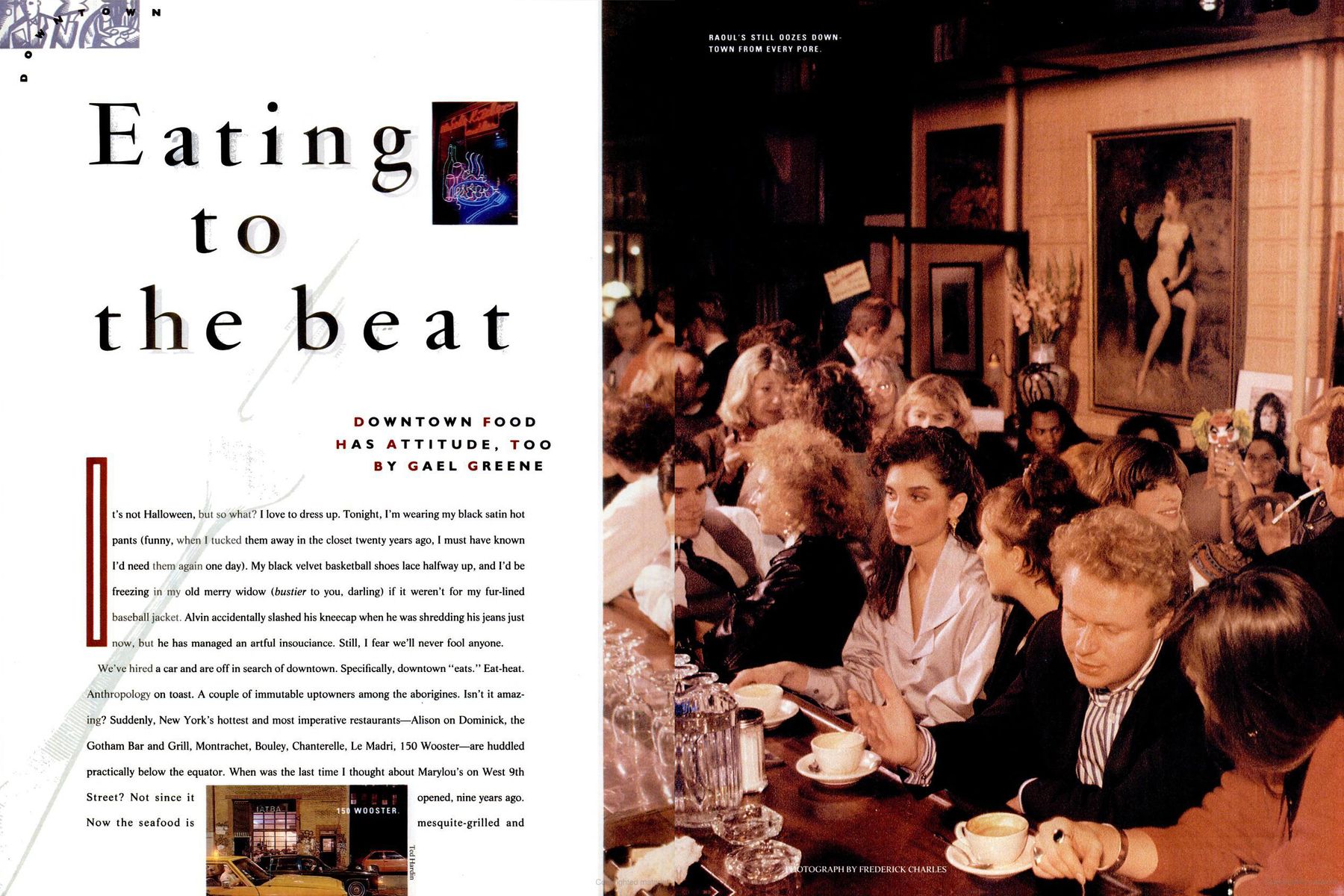
Raoul’s featured in the December 25, 1989 issue of New York.

